

Product
-
Weather station
-
Road Weather Station
-
Photovoltaic Inspection
-
Atmospheric monitoring
-
Operating condition monitoring
Recommended article
- Electrical Power Analyzer enables multi-channel power grid parameter acquisition and the detection of harmonics and unbalance
- Shandong Fengtu, a manufacturer of meteorological stations, offers high-precision weather observation equipment designed for field use
- Series power supply for EL-Based Internal Defect Detection in Photovoltaic Modules
- Shandong Fengtu, a manufacturer of meteorological monitoring instruments, produces advanced weather observation equipment
- Odor gas detector On-site Monitoring of Odorous Pollutants in Compliance with the GB14554 Standard
- Integrated Four-Parameter Weather Station for Field Meteorological Data Collection (Temperature, Humidity, Wind Speed, and Wind Direction)
Contact us
Shandong Fengtu IOT Technology Co., Ltd
Sales Manager:Ms. Emily Wang
Cel,Whatsapp,Wechat:+86 15898932201
Email:info@fengtutec.com
Add:No. 155 Optoelectronic Industry Accelerator, Gaoxin District, Weifang, Shandong, China
Pavement Condition Detectors: Advantages of Laser Remote Sensing Technology
Article source:Weather station time:2024-07-19 08:49:20 viewed:542times
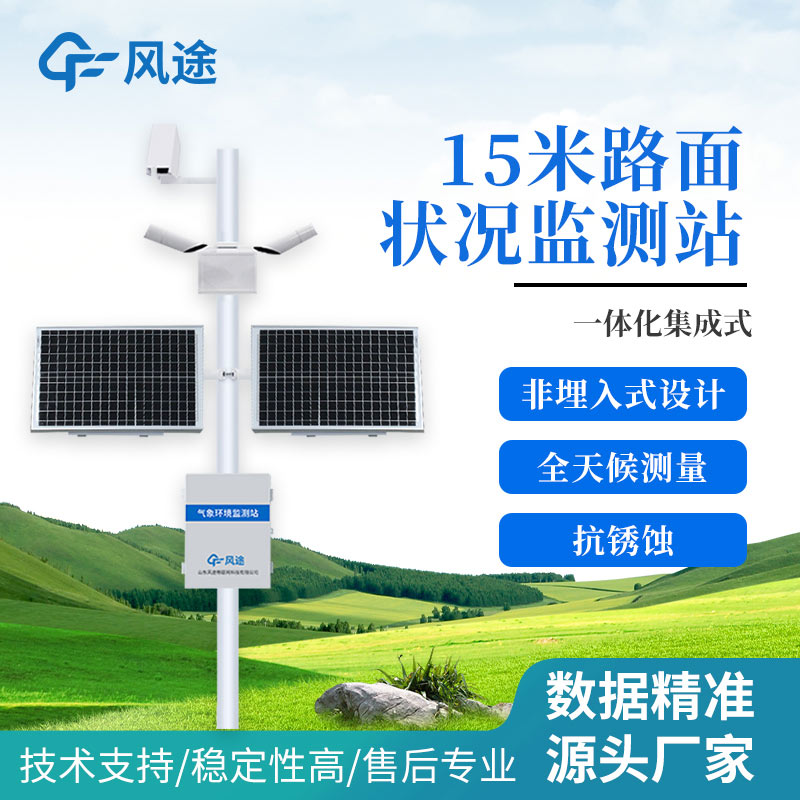
Laser remote sensing pavement condition detectors are currently available in the market as a key tool for assessing the condition of road surfaces. The ability of such devices to detect the condition of road surfaces under different environmental conditions, such as dry, wet, waterlogged, icy or snowy, provides valuable data for road maintenance and traffic management.
Laser remote sensing detectors offer significant advantages over traditional buried detection techniques.
Around 2008, buried detectors were the mainstay of the market. They needed to be installed underneath the road surface and usually relied on imports, which were not only costly but also complicated to install and maintain.
Technological advancements have continued to drive the development of detection technologies, especially the application of spectral analysis technology, which has been making its presence felt in the market since around 2015. The laser remote sensing pavement condition detector utilizes this technology to achieve non-embedded, non-contact, and long-distance measurement of pavement condition.
Laser remote sensing detectors are capable of directly inspecting travel lanes or overtaking lanes without the need to cut or install invasive equipment on the pavement. Remote measurements via laser technology have minimal impact on traffic flow, do not require traffic control, and reduce physical disruption and maintenance costs to the roadway.
By emitting a laser beam and analyzing the reflected signals, this "non-embedded" detector is able to monitor key indicators such as pavement texture, smoothness and moisture content in real time. Its ease of operation and flexibility makes road inspection more efficient and provides a more accurate scientific basis for road maintenance and traffic safety.
At present, the laser remote sensing pavement condition detector is gradually replacing the traditional buried detection method, becoming a new favorite in the field of road testing. Its non-contact detection not only improves the accuracy and efficiency of detection, but also opens up a new direction for the development of road detection technology.
This paper addresses:https://www.fengtuweather.com/industry/438.html
Related products
Related article
-
Which is the best online meteorological monitoring system?
2024-07-05 -
Shandong Fengtu, a manufacturer of meteorological observation equipment, supplies high-precision integrated field monitoring equipment
2026-08-26 -
FT-WQX8 Outdoor Weather Sensors: A Multi-Parameter Monitoring Solution for Smart Cities and Environmental Protection
2025-07-09 -
Advantages of the box-type radar speedometer
2024-01-22 -
Dust Monitoring Systems: Real-Time Solutions for Urban Dust Pollution Control
2025-05-19 -
Fengtu's Weather Monitoring Equipment: Versatile, Customizable and Network-Ready
2025-08-05 -
Police radar gun Precise, Non-Contact Speed Measurement via Radio Waves
2026-03-27 -
Ultrasonic Snow Depth Detector Automated Snow Depth Measurement Using Ultrasonic Technology
2026-08-17