

Product
-
Weather station
-
Road Weather Station
-
Photovoltaic Inspection
-
Atmospheric monitoring
-
Operating condition monitoring
Recommended article
- Electrical Power Analyzer enables multi-channel power grid parameter acquisition and the detection of harmonics and unbalance
- Shandong Fengtu, a manufacturer of meteorological stations, offers high-precision weather observation equipment designed for field use
- Series power supply for EL-Based Internal Defect Detection in Photovoltaic Modules
- Shandong Fengtu, a manufacturer of meteorological monitoring instruments, produces advanced weather observation equipment
- Odor gas detector On-site Monitoring of Odorous Pollutants in Compliance with the GB14554 Standard
- Integrated Four-Parameter Weather Station for Field Meteorological Data Collection (Temperature, Humidity, Wind Speed, and Wind Direction)
Contact us
Shandong Fengtu IOT Technology Co., Ltd
Sales Manager:Ms. Emily Wang
Cel,Whatsapp,Wechat:+86 15898932201
Email:info@fengtutec.com
Add:No. 155 Optoelectronic Industry Accelerator, Gaoxin District, Weifang, Shandong, China
Weather Monitoring Equipment Real-time Monitoring of Wind Speed, Wind Direction, Temperature, Humidity, and Atmospheric Pressure Data
Article source:Weather station time:2026-02-06 09:28:10 viewed:530times
Weather Monitoring Equipment is an intelligent device used for real-time monitoring and recording of key meteorological elements such as wind speed, wind direction, temperature, humidity, and atmospheric pressure. It provides continuous data support for fields such as agricultural management, transportation operations, emergency warning, and environmental research.
Weather Monitoring Equipment is a type of industrial-grade instrument used for automatically and continuously acquiring key meteorological parameters of the natural environment. Its core function is to replace traditional manual observation, achieving high-frequency, standardized measurement of various meteorological elements, and transmitting the data in real time to a monitoring platform or data center, providing objective basis for decision-making and operations in various industries.
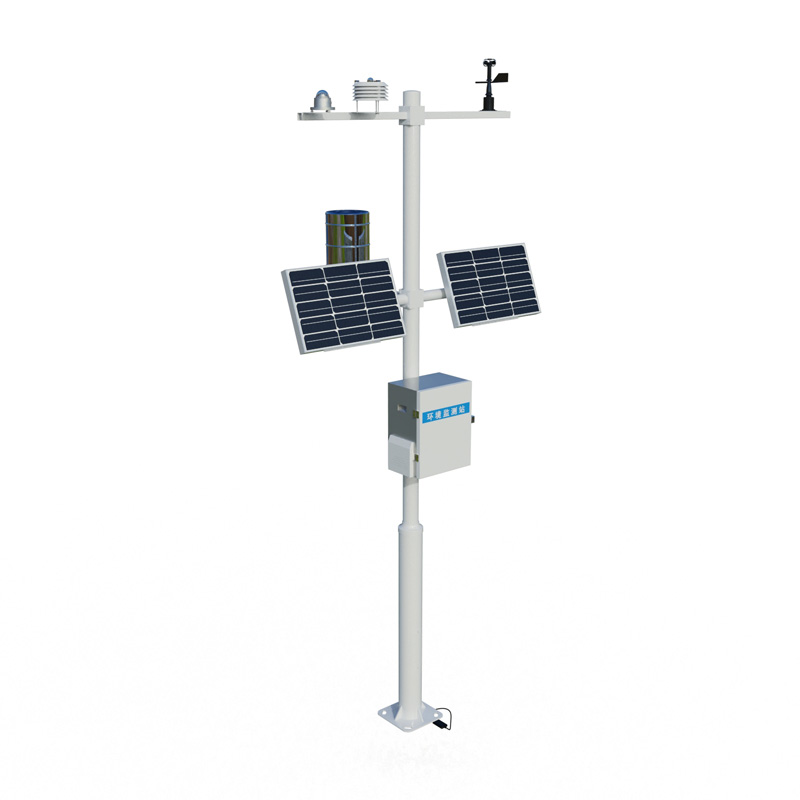
A typical weather monitoring system usually consists of a sensor unit, a data collector, a power supply module, and a communication unit. The sensor is the core component for sensing the external environment and directly determines the accuracy and reliability of the monitoring data. The basic configuration usually includes a wind speed and direction sensor for measuring air flow speed and direction, a temperature sensor for sensing temperature changes, a humidity sensor for detecting the water vapor content in the air, and an atmospheric pressure sensor for measuring atmospheric pressure. These basic elements constitute the basic data set describing near-surface weather conditions.
The data collector is responsible for receiving and processing electrical signals from the sensors, converting them into standardized meteorological data values, such as wind speed in meters per second, wind direction in degrees, and temperature in degrees Celsius. The processed data can be stored locally on the device, but more importantly, it is uploaded in real time to the user's monitoring software or cloud platform through wired or wireless communication methods such as 4G, LoRa, or Ethernet. This allows managers to remotely and continuously monitor the meteorological conditions at the monitoring point.
In practical applications, the value of Weather Monitoring EquipmentX is specifically reflected in its different deployment areas. In agricultural production, it forms the basis of smart agricultural weather stations. Real-time temperature and humidity data guide irrigation and greenhouse control, wind speed information helps assess pesticide spraying conditions, and long-term data is used to analyze local climate characteristics to optimize planting structures. In the transportation industry, especially on highways, airports, and ports, the real-time visibility, wind speed and direction, and road surface temperature data provided by the monitoring system are key information sources for issuing traffic safety warnings, implementing traffic control, and ensuring the safety of ship and aircraft takeoffs and landings.
In terms of public safety and emergency management, the role of Weather Monitoring EquipmentX is particularly prominent. Equipment deployed in forests, mountainous areas, reservoirs, and areas prone to geological disasters can capture sudden weather changes in real time, such as strong winds and precipitation, providing direct meteorological trigger parameters for early warning of flash floods, landslides, and forest fires, thus gaining valuable time for emergency response. For scientific research and environmental protection, monitoring instruments distributed across various locations, especially in remote areas, form the basic nodes of a long-term climate observation network. The continuous data they collect are indispensable scientific data for studying regional climate change and assessing environmental impacts.
Furthermore, accurate real-time meteorological data is also essential for managing large-scale outdoor events, ensuring safety at construction sites, and optimizing the operation of new energy wind farms.
In summary, [the technology/system] has surpassed the traditional scope of meteorological observation, becoming a critical industrial infrastructure. By transforming intangible environmental elements such as wind, temperature, and humidity into transmissible and analyzable digital signals, it provides a solid data foundation for refined management and scientific decision-making in various fields, including modern agriculture, intelligent transportation, public safety, and scientific research.
This paper addresses:https://www.fengtuweather.com/industry/876.html
Related products

Related article
-
What are the main classifications and common equipment of meteorological instruments?
2026-02-25 -
Windway Meteorological Observatory
2024-08-08 -
Odor gas detector is used for precise odor monitoring in multiple scenarios
2026-03-04 -
Application Introduction of Weather Monitoring Equipment High-Precision Environmental Monitoring Equipment in the Field
2026-08-21 -
What is Weather Station, and what are its functions?
2025-11-28 -
Advantages of Atmospheric Negative Oxygen Ion Monitoring System
2024-02-05 -
Vehicle - Mount Weather Stations: Applications and Advantages
2024-11-11 -
Car Vehicle Mounted Auto Weather: A Flexible and Efficient Tool for Emergency Meteorological Monitoring
2025-07-28