

Product
-
Weather station
-
Road Weather Station
-
Photovoltaic Inspection
-
Atmospheric monitoring
-
Operating condition monitoring
Recommended article
- Electrical Power Analyzer enables multi-channel power grid parameter acquisition and the detection of harmonics and unbalance
- Shandong Fengtu, a manufacturer of meteorological stations, offers high-precision weather observation equipment designed for field use
- Series power supply for EL-Based Internal Defect Detection in Photovoltaic Modules
- Shandong Fengtu, a manufacturer of meteorological monitoring instruments, produces advanced weather observation equipment
- Odor gas detector On-site Monitoring of Odorous Pollutants in Compliance with the GB14554 Standard
- Integrated Four-Parameter Weather Station for Field Meteorological Data Collection (Temperature, Humidity, Wind Speed, and Wind Direction)
Contact us
Shandong Fengtu IOT Technology Co., Ltd
Sales Manager:Ms. Emily Wang
Cel,Whatsapp,Wechat:+86 15898932201
Email:info@fengtutec.com
Add:No. 155 Optoelectronic Industry Accelerator, Gaoxin District, Weifang, Shandong, China
Evaluating Photovoltaic Module Quality with Portable EL Detectors
Article source:Weather station time:2025-08-04 09:14:18 viewed:478times
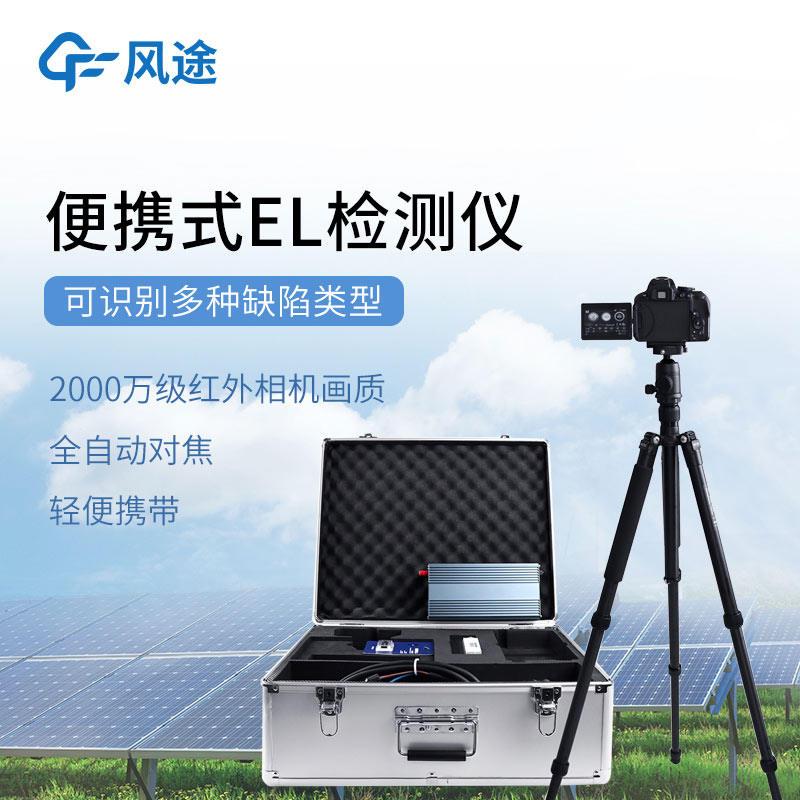
In the photovoltaic industry, judging the quality of photovoltaic modules requires professional testing tools, and the Portable EL Detector is one of the important ones. It can help inspectors quickly grasp the internal conditions of modules in different scenarios.
The working principle of the Portable EL Detector is based on the electroluminescence characteristics of photovoltaic modules. When a reverse voltage is applied to a photovoltaic module, the semiconductor materials inside the module will emit light of a specific wavelength. This kind of light is difficult to observe directly with the naked eye, but the Portable EL Detector can capture this light and convert it into a visible image. Through these images, inspectors can clearly see the internal structure of the module and possible defects.
When using the Portable EL Detector to judge the quality of photovoltaic modules, the main aspects are as follows. First, observe whether there are dark cells inside the module. A normal cell shows uniform brightness in the EL image, while a dark cell shows a significantly lower brightness in a local area. This may be due to quality problems of the cell itself, such as uneven doping, which will affect the power generation efficiency of the module.
Second, check for grid breakage. Grid breakage refers to the fracture of the metal grid lines on the surface of the cell, which is manifested as discontinuous lines in the EL image. The function of the grid lines is to collect current. Grid breakage will hinder current collection, reduce the output power of the module, and is a relatively serious quality problem.
Third, check for hidden cracks. Hidden cracks are tiny cracks inside the cell, which present irregular dark lines in the EL image. The existence of hidden cracks will affect the mechanical strength and electrical performance of the cell. With the passage of service time, hidden cracks may gradually expand, further affecting the service life and power generation effect of the module.
In addition, attention should be paid to the welding situation inside the module. Good welding shows uniform and continuous brightness at the connection parts in the EL image, while problems such as cold welding and desoldering will cause abnormal local brightness or disconnection. Poor welding quality will lead to an increase in internal resistance of the module, resulting in power loss and affecting the overall power generation performance.
Through the detection of the above aspects of photovoltaic modules by the Portable EL Detector, a comprehensive understanding of the internal quality of the modules can be obtained, providing a reliable basis for judging whether the photovoltaic modules meet the use standards. It is mainly used in the production, installation and maintenance of photovoltaic modules.
This paper addresses:https://www.fengtuweather.com/industry/761.html
Related products
Related article
-
Odor gas detector Real-time Monitoring of Odor Concentration (OU) and Concentration of Multiple Odor Gases
2025-12-18 -
What are forest fire risk factor collection stations for?
2024-07-17 -
Road surface temperature monitoring station application range
2024-06-25 -
Shandong Fengtu, a manufacturer of meteorological monitoring instruments, produces advanced weather observation equipment
2026-10-20 -
Fengtu: Leading Provider of Weather Instruments and Environmental Monitoring Equipment
2025-03-06 -
FT-CZ5S Vehicle-Mount Weather Station: Ideal for Off-Road Vehicles with All-Weather Monitoring Capabilities
2025-05-22 -
Natural Oxygen Bars in Scenic Spots: Negative Ion Monitoring for Healthy Tourism Development
2025-06-18 -
How Photovoltaic Solar Environmental Monitoring System Empowers Fishery-Photovoltaic Complementation
2024-12-16