

Product
-
Weather station
-
Road Weather Station
-
Photovoltaic Inspection
-
Atmospheric monitoring
-
Operating condition monitoring
Recommended article
- Electrical Power Analyzer enables multi-channel power grid parameter acquisition and the detection of harmonics and unbalance
- Shandong Fengtu, a manufacturer of meteorological stations, offers high-precision weather observation equipment designed for field use
- Series power supply for EL-Based Internal Defect Detection in Photovoltaic Modules
- Shandong Fengtu, a manufacturer of meteorological monitoring instruments, produces advanced weather observation equipment
- Odor gas detector On-site Monitoring of Odorous Pollutants in Compliance with the GB14554 Standard
- Integrated Four-Parameter Weather Station for Field Meteorological Data Collection (Temperature, Humidity, Wind Speed, and Wind Direction)
Contact us
Shandong Fengtu IOT Technology Co., Ltd
Sales Manager:Ms. Emily Wang
Cel,Whatsapp,Wechat:+86 15898932201
Email:info@fengtutec.com
Add:No. 155 Optoelectronic Industry Accelerator, Gaoxin District, Weifang, Shandong, China
Ice Sensor Systems: Early Warning and Prevention of Transmission Line Icing Disasters
Article source:Weather station time:2025-10-15 09:30:53 viewed:608times
Transmission line icing is a severe natural disaster that power systems face during cold seasons, particularly when encountering freezing rain, sleet, or freezing fog conditions. When the ambient temperature drops below zero degrees Celsius, supercooled water droplets, freezing rain, or snowflakes in the atmosphere collide with transmission line facilities below the freezing point, they rapidly freeze and adhere to the surfaces of conductors, ground wires, insulators, and tower fittings, forming a dense and strongly adhesive ice layer. If this process continues to develop, the ice layer will thicken continuously, eventually forming a severe icing phenomenon.
The hazards of icing to transmission lines are multifaceted. First, the weight of the ice layer itself significantly increases the mechanical load on conductors and towers, causing a substantial decrease in conductor sag, which may result in insufficient safety distances to trees and buildings below, triggering discharges. Second, under wind action, conductors with asynchronous de-icing or uneven icing are prone to galloping—this low-frequency, large-amplitude oscillation can wear conductors, damage hardware, and even cause phase-to-phase short circuits or line tripping. In the most severe cases, excessively thick ice may directly exceed the design mechanical strength limit of the line, triggering catastrophic accidents such as conductor breakage and tower collapse, resulting in large-scale and prolonged power outages that bring enormous impacts to social economy and people's lives.
To proactively defend against icing disasters and ensure grid safety, real-time and accurate monitoring of line icing conditions has become a fundamental and critical technical measure. Ice sensors are specialized devices designed for this purpose. They are directly installed on transmission lines in field locations and can continuously perceive changes in the surrounding atmospheric conditions and the physical state of their own surfaces.
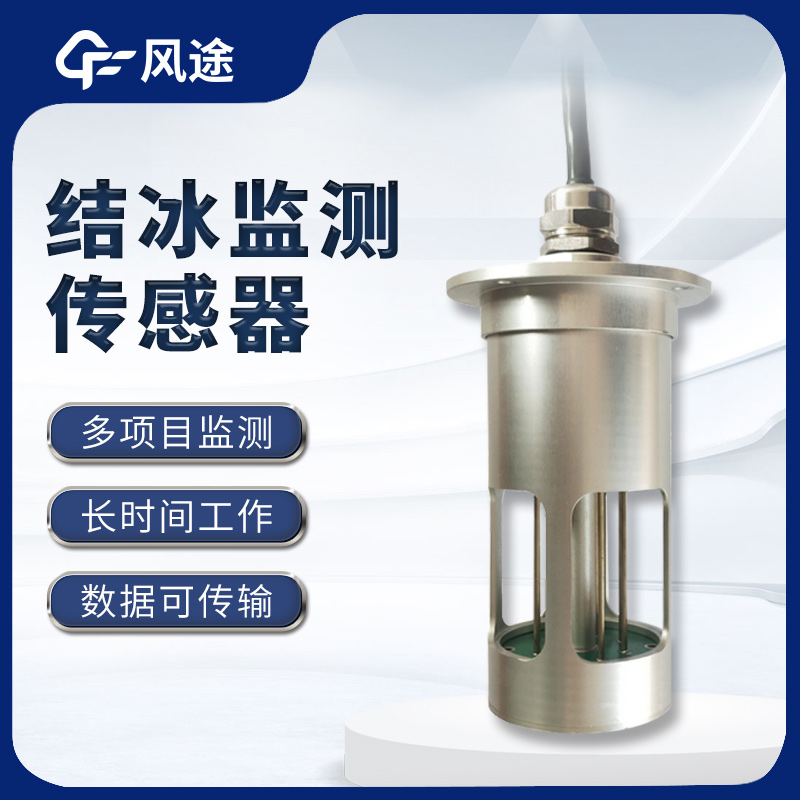
For example, the FT-JB1H Ice Sensor can detect the exact moment when icing begins to form. It directly contacts the external environment through its sensing elements, and once it detects the start of ice formation, it immediately converts this physical state change into a standard electrical signal. This signal is then transmitted through an integrated communication module via wired or wireless transmission networks, sending the critical status information that "the line has started to ice," along with an accurate timestamp, to remote power dispatching or monitoring centers in real-time.
The value of this information lies in its timeliness and directness. It enables operation and maintenance personnel to receive alerts at the earliest stage of icing development, thereby gaining valuable time for subsequent decision-making and actions. Based on the on-site first-hand data provided by the Ice Sensor, the grid control center can scientifically activate DC de-icing devices, adjust grid operation modes to transfer loads, or promptly organize inspection and emergency de-icing teams, achieving a transformation from passive response to active warning and precise intervention.
This paper addresses:https://www.fengtuweather.com/industry/811.html
Related products
Related article
-
Integrated Four-Parameter Weather Station for Field Meteorological Data Collection (Temperature, Humidity, Wind Speed, and Wind Direction)
2026-10-15 -
The price of fully automatic mini weather stations varies from 3900 to 9800 yuan depending on the number of monitored parameters
2026-05-15 -
Application Introduction of Weather Monitoring Equipment High-Precision Environmental Monitoring Equipment in the Field
2026-08-21 -
Mechanical weather station fills the "blind spots" in meteorological monitoring!
2024-09-23 -
Online dust particle counter in Clean Manufacturing Environments
2025-11-04 -
Dust monitoring system for in-depth environmental protection
2024-02-20 -
Solar-Powered IoT Monitoring: The FengTu FT-QC12 Automatic Weather Station
2025-11-05 -
The Portable Meteorograph for Mobile Weather Tracking
2024-09-02