

Product
-
Weather station
-
Road Weather Station
-
Photovoltaic Inspection
-
Atmospheric monitoring
-
Operating condition monitoring
Recommended article
- Electrical Power Analyzer enables multi-channel power grid parameter acquisition and the detection of harmonics and unbalance
- Shandong Fengtu, a manufacturer of meteorological stations, offers high-precision weather observation equipment designed for field use
- Series power supply for EL-Based Internal Defect Detection in Photovoltaic Modules
- Shandong Fengtu, a manufacturer of meteorological monitoring instruments, produces advanced weather observation equipment
- Odor gas detector On-site Monitoring of Odorous Pollutants in Compliance with the GB14554 Standard
- Integrated Four-Parameter Weather Station for Field Meteorological Data Collection (Temperature, Humidity, Wind Speed, and Wind Direction)
Contact us
Shandong Fengtu IOT Technology Co., Ltd
Sales Manager:Ms. Emily Wang
Cel,Whatsapp,Wechat:+86 15898932201
Email:info@fengtutec.com
Add:No. 155 Optoelectronic Industry Accelerator, Gaoxin District, Weifang, Shandong, China
Principles and Applications of Online dust particle counter
Article source:Weather station time:2025-11-21 09:37:48 viewed:690times
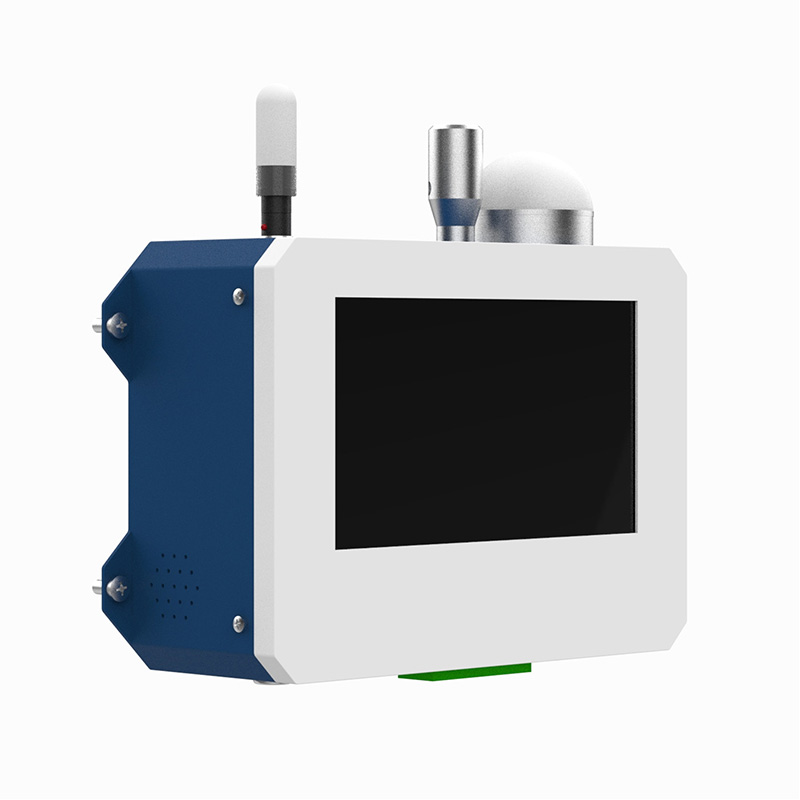
Online dust particle counter utilizes the principle of optical scattering to detect particulate matter ranging from 0.3μm to 10μm, suitable for real-time monitoring in clean environments.
Online dust particle counter is a high-precision detection device based on the principle of optical scattering, primarily used for real-time monitoring of the quantity and size distribution of suspended particulate matter in a unit volume of air. Its core working principle involves using a built-in fan to draw air into the detection chamber, causing the particulate matter to generate scattered light signals under laser beam illumination. This signal is converted into an electrical signal by a photoelectric detector, and then analyzed by an algorithm to calculate the specific quantity and size of the particulate matter. Typical devices support simultaneous detection in six channels: 0.3μm, 0.5μm, 1.0μm, 2.5μm, 5.0μm, and 10.0μm.
In terms of technical features, these counters possess high accuracy and long-term stability. For example, some models offer detection accuracy of ±10% (0.3μm channel) and ±5% (≥0.5μm channels), and are equipped with a long-life linear laser and automatic calibration function, with an average mean time between failures exceeding 5000 hours. The device typically supports sampling flow rates of 28.3L/min or 100L/min, and integrates over 8GB of storage space, capable of saving tens of thousands of sets of historical data. Communication interfaces include RS485, Ethernet, and 4G/LoRa wireless transmission, compatible with Modbus-RTU/TCP protocol, enabling real-time data interaction with cloud platforms or local systems. Furthermore, an IP55 or higher protection rating allows it to adapt to high-temperature, high-humidity, or dusty environments, requiring only monthly cleaning and maintenance.
Online dust particle counter applications cover multiple fields with strict cleanliness requirements. In semiconductor manufacturing and pharmaceutical GMP workshops, it is used for continuous monitoring of cleanroom levels to ensure compliance with ISO 14644-1 standards. Lithium battery workshops and food processing plants use it to monitor particulate concentrations in the production environment to prevent product contamination. Medical settings such as hospital operating rooms and laboratories rely on the equipment to ensure air quality, while public places (such as airports and shopping malls) use it for PM2.5/PM10 warnings. The device can also be used for compressed air testing, industrial process emission monitoring (such as in the spraying and printing industries), and particulate matter diffusion research in atmospheric physics. When selecting the Online dust particle counter device, it's necessary to consider actual needs. For example, the basic model features six-channel detection and local display functions, suitable for routine monitoring in conventional cleanrooms; the high-end model adds solar power supply, intelligent alarm functions (such as SMS/APP push notifications), and a dust source identification module, suitable for remote or complex industrial environments. During installation, avoid obstructions, regularly calibrate the sensors, and utilize functions such as backflushing valves to maintain sampling accuracy. Through proper configuration, this device can effectively support clean environment control, pollution source tracing, and scientific data analysis, becoming a core tool for air quality management.
This paper addresses:https://www.fengtuweather.com/industry/841.html
Related products
Related article
-
Meteorological observation station Observes Localized Meteorological Data
2026-03-09 -
Shandong Fengtu, a manufacturer of meteorological observation equipment, supplies high-precision integrated field monitoring equipment
2026-08-26 -
Road Weather Station: Ensuring Safe Transportation with Precise Monitoring
2024-09-14 -
Negative Oxygen Ion Monitoring Station: An Automated Solution for 24/7 Air Cleanliness Monitoring in Scenic Areas
2025-09-01 -
Odor gas detector is used for precise odor monitoring in multiple scenarios
2026-03-04 -
What Testing Instruments are Required for Photovoltaic Power Generation Acceptance?
2026-08-11 -
Strategies for Using Dust Detectors to Avoid Penalties under Stringent Environmental Regulations
2025-06-10 -
FT-CZ5S Vehicle-Mount Weather Station: Ideal for Off-Road Vehicles with All-Weather Monitoring Capabilities
2025-05-22