

Product
-
Weather station
-
Road Weather Station
-
Photovoltaic Inspection
-
Atmospheric monitoring
-
Operating condition monitoring
Recommended article
- Electrical Power Analyzer enables multi-channel power grid parameter acquisition and the detection of harmonics and unbalance
- Shandong Fengtu, a manufacturer of meteorological stations, offers high-precision weather observation equipment designed for field use
- Series power supply for EL-Based Internal Defect Detection in Photovoltaic Modules
- Shandong Fengtu, a manufacturer of meteorological monitoring instruments, produces advanced weather observation equipment
- Odor gas detector On-site Monitoring of Odorous Pollutants in Compliance with the GB14554 Standard
- Integrated Four-Parameter Weather Station for Field Meteorological Data Collection (Temperature, Humidity, Wind Speed, and Wind Direction)
Contact us
Shandong Fengtu IOT Technology Co., Ltd
Sales Manager:Ms. Emily Wang
Cel,Whatsapp,Wechat:+86 15898932201
Email:info@fengtutec.com
Add:No. 155 Optoelectronic Industry Accelerator, Gaoxin District, Weifang, Shandong, China
Multifunctional weather station Technical Features and Application Fields
Article source:Weather station time:2025-12-26 09:37:35 viewed:571times
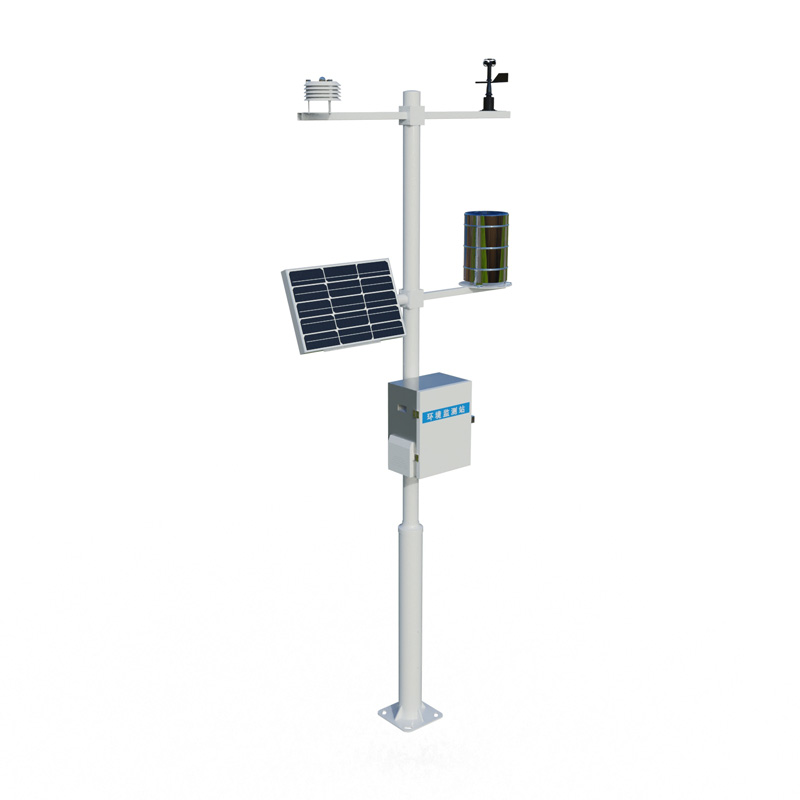
Multifunctional weather station integrates temperature, humidity, atmospheric pressure, wind speed, wind direction, precipitation, and light intensity monitoring functions. It features high integration, high precision, maintenance-free operation, and a long lifespan. It can automatically collect, process, and transmit data 24/7, and is widely used in wind power generation, power safety, meteorology, and urban environmental monitoring.
Multifunctional weather station is an integrated automatic meteorological observation device that can simultaneously monitor seven core meteorological parameters: temperature, humidity, atmospheric pressure, wind speed, wind direction, precipitation, and light intensity. It collects data in real-time through a high-precision sensor array, and the data is automatically processed and stored by an internal processor. The device typically employs a low-power design, using a solar power system and wireless communication module to achieve long-term, unattended continuous operation in the field.
In terms of technical composition, the temperature sensor uses high-precision thermistors or digital chips, with a measurement range typically covering -50 to +70 degrees Celsius. The humidity sensor is based on the capacitive principle, measuring atmospheric relative humidity. The atmospheric pressure sensor uses silicon piezoresistive or capacitive MEMS chips, providing accurate atmospheric pressure data. Wind speed and wind direction sensors use mechanical wind cups and vanes or ultrasonic principles to measure wind conditions in real-time. Precipitation is measured by a tipping bucket rain gauge, recording the cumulative amount of liquid precipitation. The light intensity sensor is based on the photoelectric effect, measuring the visible light portion of solar radiation. All sensor signals are processed uniformly by the data acquisition unit and converted into standard meteorological data formats.
The core advantage of Multifunctional weather station lies in its high degree of integration and automation. Traditional meteorological observation requires multiple independent instruments to be installed and maintained separately, while Multifunctional weather station integrates all sensors into a compact enclosure or mast system, significantly reducing installation space and wiring complexity. The device adopts an industrial-grade protection design, with a rainproof, dustproof, and UV-resistant casing. The sensors are temperature-compensated and linearly calibrated to ensure measurement accuracy in different environments. Its maintenance-free characteristics are reflected in its sealed structure, corrosion-resistant materials, and self-diagnostic functions, allowing for long-term stable operation without frequent on-site maintenance. The service life is typically 5 years or more, with core components designed for even longer lifespans.
The device's workflow is fully automated. The data acquisition unit reads data from each sensor at preset time intervals, performing quality control, unit conversion, and preliminary statistical calculations. The processed data can be transmitted via wired or wireless methods, supporting various communication protocols such as RS485, Ethernet, 4G, and LoRa. Users can view data in real time, download historical records, and set alarm thresholds through a cloud platform or local software. The device's built-in memory card ensures data is not lost during network interruptions. The entire system is designed to withstand a wide range of climatic conditions, from extreme cold to high temperatures and from humid to dry environments, enabling true all-weather monitoring.
In terms of applications, Multifunctional weather station plays a crucial role. In the wind power industry, it provides continuous wind condition data for wind farm site selection, wind turbine power curve verification, and operational wind resource assessment, directly impacting power generation efficiency evaluation. In power grid safety monitoring, deployed along transmission lines, it monitors micro-meteorological conditions, providing data for icing and strong wind warnings, ensuring the safe operation of the power grid. In meteorological monitoring, as an important component of automatic weather station networks, it compensates for the insufficient spatial density of traditional weather stations, providing more detailed local weather data for weather forecasting and climate research. In urban environmental monitoring, it helps environmental protection departments understand urban heat island effects, rainfall distribution, and sunlight conditions, providing data support for urban planning, pollution dispersion analysis, and public meteorological services.
With the development of the Internet of Things and intelligent sensing technologies, Multifunctional weather station is evolving towards lower power consumption, higher intelligence, and stronger compatibility. In the future, it will be further integrated into smart city and industrial internet systems, providing reliable meteorological data solutions for more industries and becoming a fundamental node in environmental sensing networks. Through continuous technological optimization and application expansion, Multifunctional weather station will maintain its key position in the modernization of meteorological services.
This paper addresses:https://www.fengtuweather.com/technical/861.html
Related products
Related article
-
System framework for digital weather stations
2024-05-10 -
The Vehicle-Mount Weather Station: Enabling Mobile Meteorological Monitoring for Emergency Response and Beyond
2025-09-26 -
Portable Ground Penetrating Radar: Detecting Hidden Pipelines and Curbing Illegal Discharges in Urban Settings
2025-02-27 -
Automated systems for meteorological stations
2024-04-18 -
Weather Monitoring Equipment Real-time Monitoring of Wind Speed, Wind Direction, Temperature, Humidity, and Atmospheric Pressure Data
2026-02-06 -
Integrated meteorological monitoring station High-Efficiency Monitoring for Multi-Domain Applications
2026-01-28 -
Compliant and Comprehensive: Fengtu's Online Dust Particle Counter for Electronic Cleanrooms
2025-07-11 -
Introduction to the Features of the Small Automatic Weather Station
2024-09-09