

Product
-
Weather station
-
Road Weather Station
-
Photovoltaic Inspection
-
Atmospheric monitoring
-
Operating condition monitoring
Recommended article
- Odor gas detector Enabling Precision, Round-the-Clock Monitoring of Fugitive Emissions in Industrial Facilities
- Compact Weather Stations: High-Precision Field Monitoring for Diverse Scenarios
- Shandong Fengtu, a renowned manufacturer of environmental monitoring instruments, supplies a wide range of field and online monitoring equipment
- Weather Monitoring Equipment enables high-precision, automated environmental parameter monitoring in field settings
- Introduction to the Principles, Applications, and Technical Specifications of Speed enforcement system
- Forest Weather Station Facilitates Precise Monitoring and Scientific Prevention of Forest Fires
Contact us
Shandong Fengtu IOT Technology Co., Ltd
Sales Manager:Ms. Emily Wang
Cel,Whatsapp,Wechat:+86 15898932201
Email:info@fengtutec.com
Add:No. 155 Optoelectronic Industry Accelerator, Gaoxin District, Weifang, Shandong, China
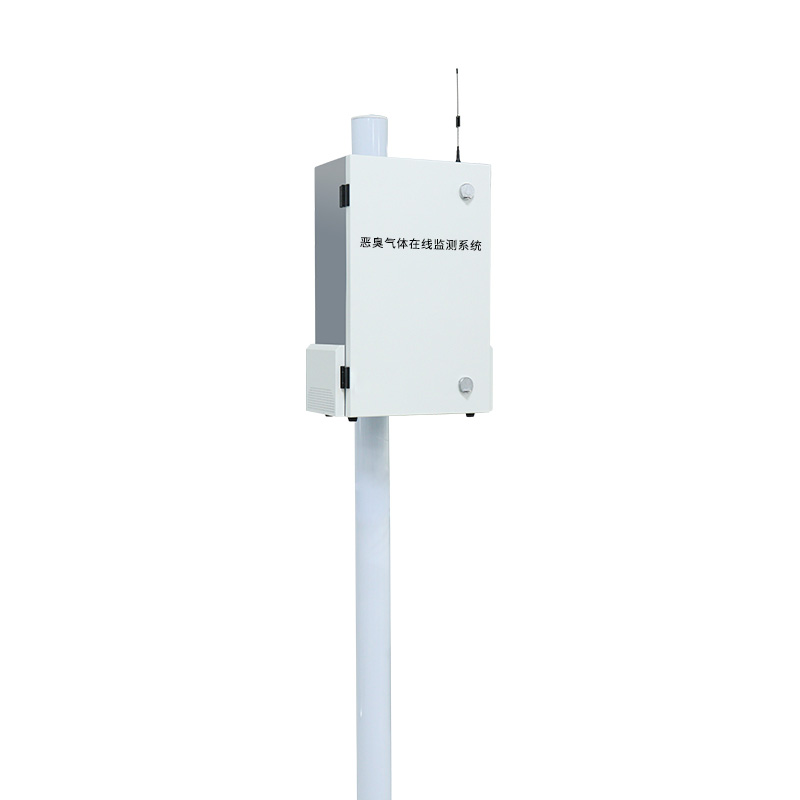
Odor Monitoring System achieves 24-hour gas concentration monitoring through a multi-sensor array
Article source:Weather station time:2026-05-14 10:05:17 viewed:276times
Odor Monitoring System integrates a hybrid array of metal oxide sensors, PID photoionization detectors, and electrochemical sensors. It monitors the concentrations of characteristic gases such as NH₃, H₂S, and TVOC in real time and calculates the OU value, enabling continuous 24-hour data acquisition, automatic early warning for exceeding standards, and pollution source tracing. It is suitable for odor pollution scenarios such as waste treatment, sewage treatment, and chemical industrial parks.
Odor Monitoring System is primarily designed for locations with concentrated odor pollution sources, such as waste treatment plants, sewage treatment plants, chemical industrial parks, and livestock farms. It can perform 24-hour continuous online monitoring of characteristic odorous gases in the air. The system generally adopts multi-sensor hybrid array technology, with sensor types including metal oxide sensors, PID photoionization detectors, and electrochemical sensors. Through the combination and configuration of multiple sensor types, it covers the detection needs of odorous gases with different chemical properties.
In terms of gas types monitored, the Odor Monitoring System system can detect eight characteristic odorous gases, including ammonia, hydrogen sulfide, trimethylamine, carbon disulfide, methanethiol, styrene, dimethyl sulfide, and dimethyl disulfide, and simultaneously calculate the odor intensity (OU) value. Some devices can also add monitoring for total volatile organic compounds (TVOC) and VOCs, basically covering the typical odorous pollutants specified in the national standard GB14554. Regarding sensor detection accuracy, the system has a range of 0 to 10 ppm for hydrogen sulfide and 0 to 50 ppm for ammonia, with a resolution of up to 0.001 ppm, an accuracy of ±5%FS, and a response time (T90) of no more than 30 seconds. For data processing, the system is equipped with a microprocessor to perform temperature compensation, cross-interference correction, and odor intensity model calculations on multi-channel signals, ultimately displaying the concentration values on a touchscreen and uploading them to the environmental monitoring platform or central control system via 4G, Wi-Fi, or RS485 interfaces.
In terms of product protection and structure, Odor Monitoring System typically supports outdoor installation, with a protection rating of IP65 or higher and an operating temperature range covering -20℃ to 60℃. Some devices have an explosion-proof rating of Ex ib IIC T4 Gb, making them suitable for installation near flammable and explosive environments such as chemical plants. The equipment supports AC220V or DC24V power supply, and some models offer optional solar power systems and pole-mounted installation components to adapt to different site conditions.
Regarding data management and early warning, Odor Monitoring System generally features a three-level audible and visual alarm and SMS or APP push notification functions. When a level is exceeded, the audible and visual alarm is immediately triggered, and a platform push notification is sent. Simultaneously, the relay output links with the deodorization equipment, achieving closed-loop control of monitoring and treatment. The system can store more than 120 days of historical data, which is not lost when the network is down and is automatically re-uploaded upon reconnection. The platform supports unified monitoring of multiple devices across regions, and uses meteorological parameters such as wind speed and direction to predict and analyze the odor diffusion range, providing decision-making basis for emergency response command by environmental protection departments. The system can also connect to provincial and municipal ecological and environmental monitoring platforms, and upload data in accordance with protocols such as HJ212 to meet the requirements of environmental protection departments for record verification and traceability of exceeding standards.
This paper addresses:https://www.fengtuweather.com/company/940.html
Related products
Related article
-
How much does a small weather station cost?
2026-02-04 -
Advantages of Negative Oxygen Ion Monitoring Stations
2024-03-12 -
On - the - Go Meteorology: Unraveling the Power of Vehicle - Mount Weather Stations
2025-01-21 -
Forestry Weather Station: A Powerful Tool for Forest and Grassland Fire Prevention and Control
2025-07-08 -
What Are Your Goals for Weather Monitoring? How to Configure a Suitable Automatic Weather Station According to Your Needs?
2024-11-15 -
Voltage Quality Challenges and Solutions with Power Quality Analyzers (FT - DN2)
2025-03-13 -
Advanced Road Weather Station for Traffic Safety
2024-08-27 -
Data-Driven Stewardship: The FT-CQX9 Grassland ecological monitoring station for Grassland Protection and Sustainable Livestock Farming
2025-11-13