

Product
-
Weather station
-
Road Weather Station
-
Photovoltaic Inspection
-
Atmospheric monitoring
-
Operating condition monitoring
Recommended article
- Electrical Power Analyzer enables multi-channel power grid parameter acquisition and the detection of harmonics and unbalance
- Shandong Fengtu, a manufacturer of meteorological stations, offers high-precision weather observation equipment designed for field use
- Series power supply for EL-Based Internal Defect Detection in Photovoltaic Modules
- Shandong Fengtu, a manufacturer of meteorological monitoring instruments, produces advanced weather observation equipment
- Odor gas detector On-site Monitoring of Odorous Pollutants in Compliance with the GB14554 Standard
- Integrated Four-Parameter Weather Station for Field Meteorological Data Collection (Temperature, Humidity, Wind Speed, and Wind Direction)
Contact us
Shandong Fengtu IOT Technology Co., Ltd
Sales Manager:Ms. Emily Wang
Cel,Whatsapp,Wechat:+86 15898932201
Email:info@fengtutec.com
Add:No. 155 Optoelectronic Industry Accelerator, Gaoxin District, Weifang, Shandong, China
What Are Your Goals for Weather Monitoring? How to Configure a Suitable Automatic Weather Station According to Your Needs?
Article source:Weather station time:2024-11-15 09:04:00 viewed:510times
What are your goals for weather monitoring? How to configure a suitable automatic weather station according to your needs?
Weather monitoring has several important goals.
Firstly, it serves meteorological forecasting. By monitoring elements such as air pressure, temperature, and humidity, short-term weather changes such as rainfall and strong winds can be predicted. For example, monitoring temperature and humidity in summer can forecast thundershowers. Long-term climate prediction also relies on this, which can guide agricultural planting arrangements.
Secondly, it is for disaster warning. For example, by monitoring the position, intensity, and moving speed of typhoons, the wind direction and speed data obtained by coastal meteorological stations can be used to issue timely warnings. Monitoring heavy rain is of great significance for preventing floods. Combining with hydrological data, floods can be predicted to protect downstream residents.
Thirdly, it is used for climate research. Long-term weather monitoring data can be used to study climate change, including the degree of global warming, climate change patterns, etc. Research on polar temperatures can help understand the impact of glacier melting on sea level. It can also study local climates, such as the microclimate in mountainous areas.
Fourthly, it is for environmental monitoring and assessment. Monitoring air quality and analyzing the spread of pollutants can issue air pollution warnings during temperature inversions and low wind speeds. Monitoring solar radiation can assess the environmental energy budget, which is beneficial for solar energy utilization planning.
Fifthly, it is to ensure the transportation and logistics industries. Airport meteorological stations monitor visibility, runway conditions, etc. to ensure flight safety, while highway transportation maintains roads according to weather conditions.
Sixthly, it serves the energy industry. Power companies predict electricity demand based on temperature, etc. The wind power and solar power generation industries assess the power generation potential by monitoring wind speed and solar radiation.
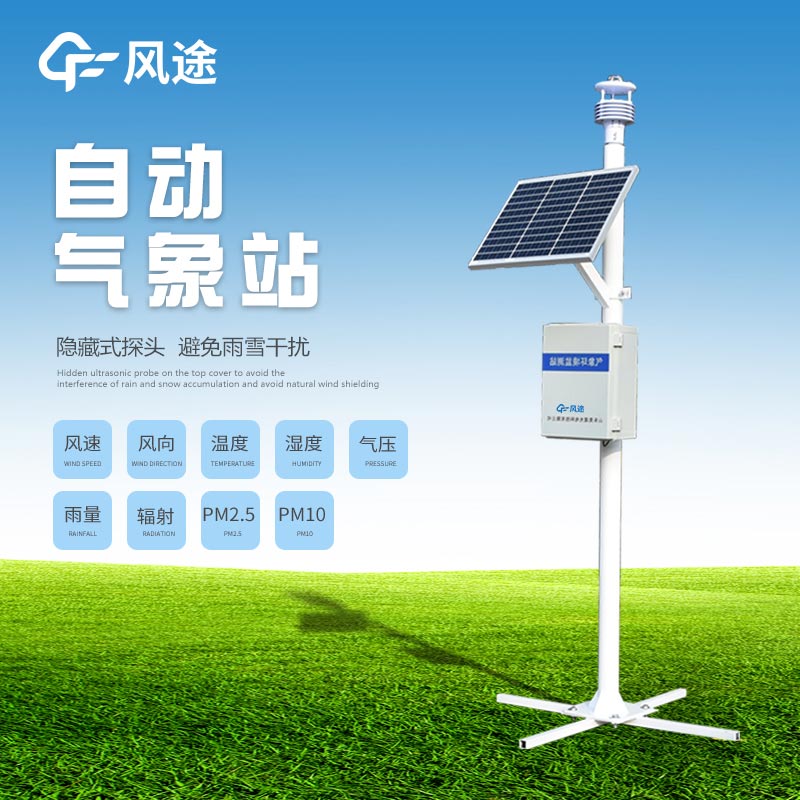
According to different needs, the configuration of automatic weather stations varies. For monitoring basic meteorological elements, a platinum resistance temperature sensor, a capacitive humidity sensor, a piezoresistive air pressure sensor, and a combination of a three-cup wind speed sensor and a wind vane can be configured. For meteorological disaster monitoring, in areas prone to heavy rain and floods, a tipping bucket rain gauge sensor should be added. In coastal areas or areas affected by typhoons, high-precision wind speed and direction sensors should be equipped, and marine meteorological buoys can be added if necessary.
Under the demand of climate research, in addition to conventional sensors, a carbon dioxide analyzer and a solar radiation sensor should be added, and a snow depth sensor should be configured in special areas. For the automatic weather station required for environmental monitoring, an air quality sensor should be equipped and combined with meteorological element sensors.
In ensuring the transportation industry, airport meteorological stations are configured with a runway visual range meter, a cloud height meter, and a pavement sensor, while pavement condition sensors are installed on highway sections. In the application of the energy industry, high-precision wind speed and direction sensors are installed at different heights in wind power farms, and a solar radiation sensor is configured in solar power farms.
This paper addresses:https://www.fengtuweather.com/industry/556.html
Related products
Related article
-
Fengtou Farming Weather Station Provides Weather Services for Sheep Farming
2024-07-29 -
Sensor Array Technology and Application Scenarios of Odor gas detector
2026-06-29 -
Odor gas detector is used for precise odor monitoring in multiple scenarios
2026-03-04 -
Weather Station Monitoring System: Components & Capabilities
2025-03-12 -
3-Meter Laser Snow Depth Monitoring Station: Non-Contact, High-Frequency Laser Measurement of Snow Thickness
2026-03-16 -
Breaking Through the ‘Last Meter’ with Online Dust Monitoring System
2025-01-10 -
Intelligent Road Weather Station: Mitigating Risks in Adverse Conditions
2025-09-22 -
What is the best Farmland Weather Station manufacturer?
2024-08-28