

Product
-
Weather station
-
Road Weather Station
-
Photovoltaic Inspection
-
Atmospheric monitoring
-
Operating condition monitoring
Recommended article
- Electrical Power Analyzer enables multi-channel power grid parameter acquisition and the detection of harmonics and unbalance
- Shandong Fengtu, a manufacturer of meteorological stations, offers high-precision weather observation equipment designed for field use
- Series power supply for EL-Based Internal Defect Detection in Photovoltaic Modules
- Shandong Fengtu, a manufacturer of meteorological monitoring instruments, produces advanced weather observation equipment
- Odor gas detector On-site Monitoring of Odorous Pollutants in Compliance with the GB14554 Standard
- Integrated Four-Parameter Weather Station for Field Meteorological Data Collection (Temperature, Humidity, Wind Speed, and Wind Direction)
Contact us
Shandong Fengtu IOT Technology Co., Ltd
Sales Manager:Ms. Emily Wang
Cel,Whatsapp,Wechat:+86 15898932201
Email:info@fengtutec.com
Add:No. 155 Optoelectronic Industry Accelerator, Gaoxin District, Weifang, Shandong, China
How Landslide Monitoring Systems Work to Mitigate Geological Hazards
Article source:Weather station time:2024-12-04 09:31:37 viewed:569times
A landslide is a common geological disaster, which refers to the phenomenon that the soil or rock mass on a hillside slides down the slope as a whole or in a scattered manner along a weak surface or weak zone under the influence of various factors and gravity.
Its formation is the result of the combined action of multiple factors. For example, in terms of topography and geomorphology, areas with a slope between 10 and 45 degrees and a large elevation difference, as well as mountains composed of loose deposits or weathered and fragmented rocks, are more prone to landslides due to their low shear strength.
Meteorological and hydrological conditions are also extremely crucial. Heavy rainfall not only increases the water content and unit weight of the rock and soil mass but also reduces the shear strength, especially during continuous heavy rainstorms. At the same time, the scouring of the slope toe by rivers will weaken the supporting force and induce landslides. The seismic waves generated by earthquakes will damage the structure of the rock and soil mass of the mountain and change the stress state, triggering landslides. For instance, the 2008 Wenchuan earthquake led to numerous mountain landslides. Human activities cannot be ignored either. Unreasonable excavation of the slope toe during engineering construction, such as improper cutting of slopes during the construction of mountain roads, and the unreasonable irrigation and drainage systems that cause abnormal changes in the groundwater level will all undermine the stability of the mountain and increase the risk of landslides.
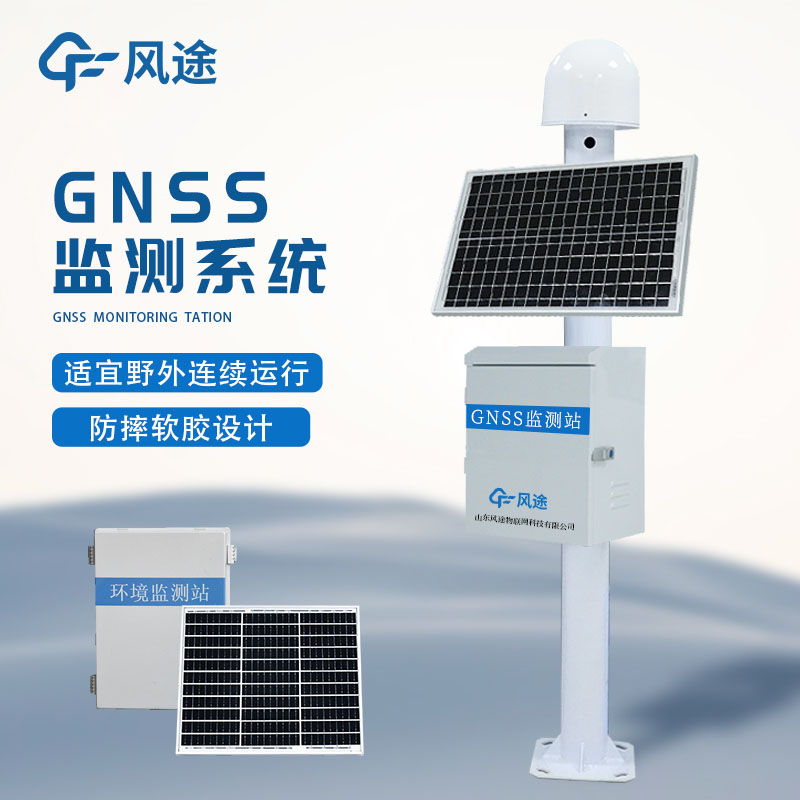
The landslide monitoring system is based on the global navigation satellite system, such as GPS and Beidou. The satellites emit signals, and the GNSS receivers fixed on the landslide body and its surroundings receive signals from multiple satellites to determine the position.
During the monitoring process, monitoring points and reference points are first reasonably arranged in different parts of the landslide body and the stable area. The receivers automatically collect data containing three-dimensional coordinates and time information at set time intervals and store or transmit them to the data processing center. During data processing, abnormal data such as noise is first removed through preprocessing, and then differential technology is used to improve the positioning accuracy. Through analysis, the change of the displacement of the monitoring point over time is obtained, and a displacement-time curve is drawn. Parameters such as the deformation rate and direction of the landslide body can also be calculated by comprehensively using the data of multiple monitoring points.
When the monitoring data shows that the landslide displacement exceeds the threshold, the system will automatically issue a warning. Relevant personnel can be notified through text messages, emails, or audible and visual alarm devices, so that emergency measures such as evacuating residents and blocking roads can be taken in a timely manner, effectively preventing the risks and losses caused by landslide disasters.
This paper addresses:https://www.fengtuweather.com/industry/569.html
Related products
Related article
-
Forestry Weather Station: A Powerful Tool for Forest and Grassland Fire Prevention and Control
2025-07-08 -
The miniature weather station equipment outputs twelve monitoring data points simultaneously via a digital interface
2026-06-03 -
Road Weather Station: Real-Time Monitoring and Early Warning for Safe Traffic Operations
2025-06-05 -
Fengtu Technology: Providing Reliable Online dust Monitoring system Solutions for Smart Environmental Management
2025-11-14 -
Smart Tourism Anion Monitoring System
2024-08-26 -
Road meteorological monitoring systems collect road condition and meteorological data to ensure road safety
2026-08-10 -
How Visibility Monitoring Stations Combat the High - Risk Patchy Fog in Traffic
2025-02-24 -
Tailored for Emergencies: The Complementary Advantages of Two Weather Monitoring Tools
2025-04-22