

Product
-
Weather station
-
Road Weather Station
-
Photovoltaic Inspection
-
Atmospheric monitoring
-
Operating condition monitoring
Recommended article
- Electrical Power Analyzer enables multi-channel power grid parameter acquisition and the detection of harmonics and unbalance
- Shandong Fengtu, a manufacturer of meteorological stations, offers high-precision weather observation equipment designed for field use
- Series power supply for EL-Based Internal Defect Detection in Photovoltaic Modules
- Shandong Fengtu, a manufacturer of meteorological monitoring instruments, produces advanced weather observation equipment
- Odor gas detector On-site Monitoring of Odorous Pollutants in Compliance with the GB14554 Standard
- Integrated Four-Parameter Weather Station for Field Meteorological Data Collection (Temperature, Humidity, Wind Speed, and Wind Direction)
Contact us
Shandong Fengtu IOT Technology Co., Ltd
Sales Manager:Ms. Emily Wang
Cel,Whatsapp,Wechat:+86 15898932201
Email:info@fengtutec.com
Add:No. 155 Optoelectronic Industry Accelerator, Gaoxin District, Weifang, Shandong, China
The Role of Ground Penetrating Radar in Addressing Municipal Infrastructure Detection Needs
Article source:Weather station time:2025-08-28 09:12:27 viewed:525times
With the acceleration of urbanization, the scale and complexity of municipal infrastructure construction have increased. Road hazard inspection, underground cavity detection, road structure layer disease diagnosis, underground pipeline network positioning, tunnel lining inspection, and hydrogeological survey have become key to ensuring the safe operation of infrastructure, improving municipal efficiency, and promoting the sustainable development of cities. These tasks directly affect the travel safety of citizens and the operation of urban functions, and their importance is becoming increasingly prominent.
Traditional detection methods have obvious limitations: Metal pipeline detectors cannot effectively identify non-metallic pipelines such as PE pipes, PVC pipes, and concrete pipes, which easily leads to omissions in inspections; the hole-digging method and drilling method damage the road structure, affect traffic, and incur high repair costs; hydrogeological surveys have high requirements for equipment and personnel, are complicated and time-consuming to operate, and are interfered by geological and environmental factors, resulting in poor result stability. Under such circumstances, radar detection technology, which has the advantages of non-destructiveness and high efficiency, has become the mainstream in municipal detection.
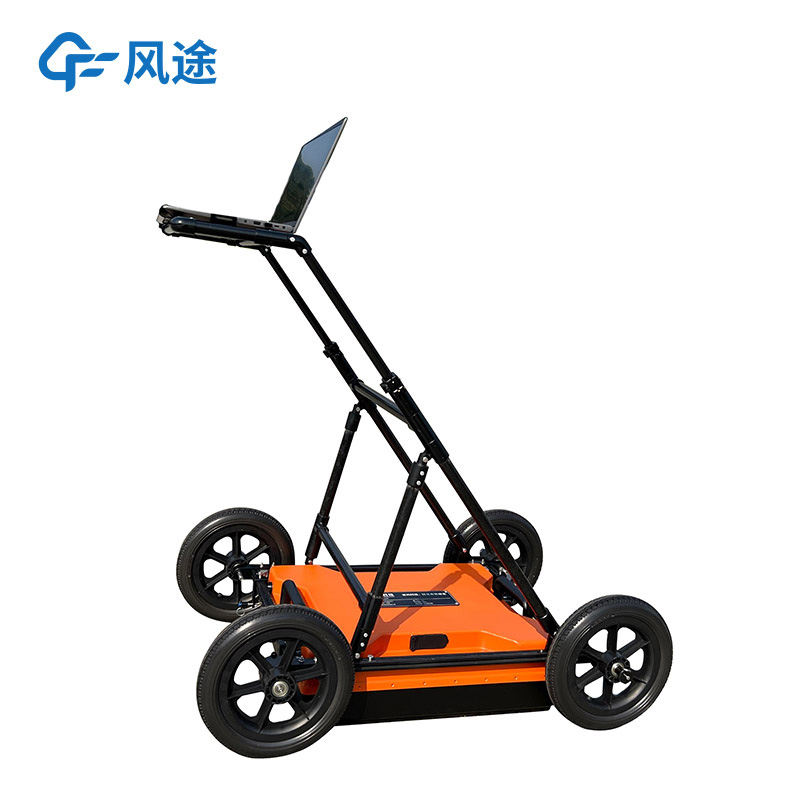
Ground Penetrating Radar realizes underground detection through high-frequency radar pulses: the transmitting antenna emits electromagnetic waves underground. When the electromagnetic waves come into contact with the interface of different media (such as the boundary between pipelines and soil, or cavities and rock formations), they are reflected. After the receiving antenna captures the signals, the signals are processed and analyzed to generate 3D visualized images of the underground structure. This technology has high resolution, wide detection depth, and strong environmental adaptability. It can effectively identify underground pipelines, cavities, obstacles, etc., and provide a scientific basis for municipal planning, construction, and maintenance.
In municipal applications, Ground Penetrating Radar can accurately detect metal pipelines and non-metallic pipelines such as PE pipes, PVC pipes, and cement pipes, and automatically generate pipeline network maps to improve inspection efficiency; it can efficiently locate underground structures such as tunnels, civil air defense projects, underground spaces, and karst structures; it can also be used for monitoring potential road collapse hazards and classifying underground soil, providing support for municipal departments to warn of risks and formulate maintenance plans.
This paper addresses:https://www.fengtuweather.com/industry/781.html
Related products

Related article
-
Weather Monitoring Equipment system comprises five parts: a sensor, a data logger, a solar power supply, a pole support, and a cloud platform
2026-05-12 -
Infrared Thermal Imaging Camera FT-HYS5: Breaking Visual Barriers for Efficient and Safe Underwater Operations
2025-07-15 -
Scenic Negative Oxygen Ion Environmental Monitoring Station
2024-08-01 -
Fire Risk Factor Integrated Monitoring Station Instructions
2024-07-03 -
PV Module Power Tester Enables Precise Testing of 1500V High-Voltage Modules
2026-03-18 -
Application of the Series power supply 1500V High-Voltage Output in EL Testing
2026-07-15 -
Meteorological Monitoring for Drone Takeoff and Landing: Application of Vehicle Weather Station
2025-05-20 -
Road Weather Information System: Key to Mitigating Weather - Related Traffic Hazards
2025-02-12