

Product
-
Weather station
-
Road Weather Station
-
Photovoltaic Inspection
-
Atmospheric monitoring
-
Operating condition monitoring
Recommended article
- Electrical Power Analyzer enables multi-channel power grid parameter acquisition and the detection of harmonics and unbalance
- Shandong Fengtu, a manufacturer of meteorological stations, offers high-precision weather observation equipment designed for field use
- Series power supply for EL-Based Internal Defect Detection in Photovoltaic Modules
- Shandong Fengtu, a manufacturer of meteorological monitoring instruments, produces advanced weather observation equipment
- Odor gas detector On-site Monitoring of Odorous Pollutants in Compliance with the GB14554 Standard
- Integrated Four-Parameter Weather Station for Field Meteorological Data Collection (Temperature, Humidity, Wind Speed, and Wind Direction)
Contact us
Shandong Fengtu IOT Technology Co., Ltd
Sales Manager:Ms. Emily Wang
Cel,Whatsapp,Wechat:+86 15898932201
Email:info@fengtutec.com
Add:No. 155 Optoelectronic Industry Accelerator, Gaoxin District, Weifang, Shandong, China
Grassland Ecological Monitoring Station - Empowering Sustainable Grazing
Article source:Weather station time:2024-12-13 09:55:54 viewed:523times
Meteorological monitoring on pastures is of great necessity. In terms of forage growth, temperature affects the growth rate and quality of different forage varieties. Either too high or too low temperature is unfavorable, and meteorological monitoring can provide a basis for measures to adjust the temperature. Excessive or insufficient precipitation can lead to waterlogging and drought respectively, threatening the survival of forage. Monitoring precipitation allows for timely responses. Illumination is crucial for the photosynthesis of forage, and monitoring illumination can optimize the planting density and variety selection. For livestock breeding, high temperatures easily cause heat stress in livestock, and cold temperatures easily lead to frostbite and illness. Meteorological monitoring can provide early warnings to take protective measures. Moreover, weather changes affect the behavior and reproduction of livestock, based on which reasonable arrangements for management and mating can be made. In terms of pasture facilities and management, extreme weather can damage fences, livestock sheds and other facilities. Monitoring can enable early reinforcement. At the same time, meteorological data can be used to scientifically plan feed reserves and pasture layout. For example, drainage facilities can be set up in flood-prone areas, and open-air breeding areas can be built in areas with good illumination, safeguarding the stable and efficient operation of the pasture.
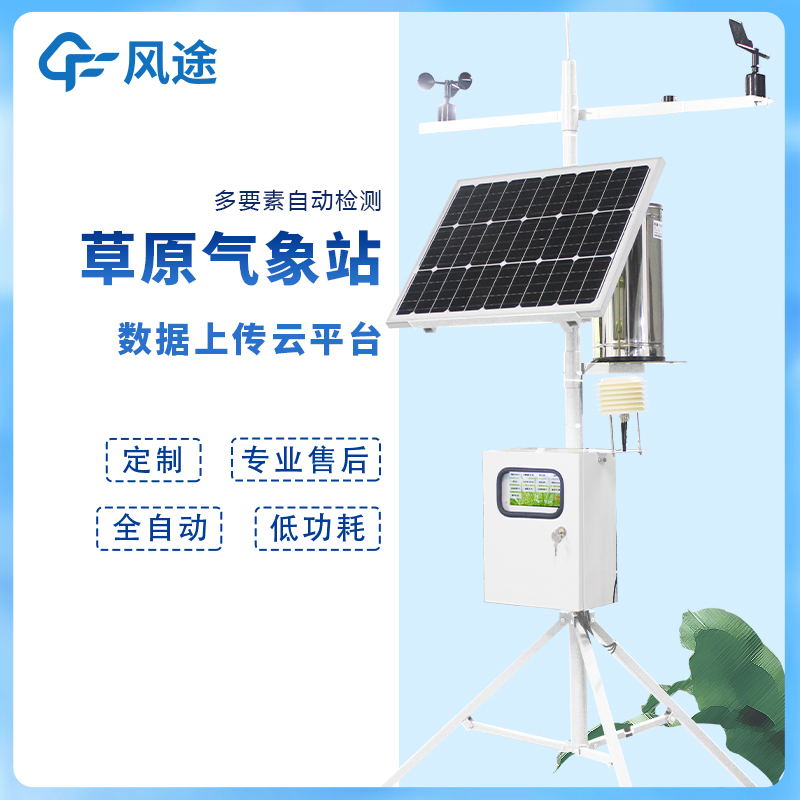
The nine-element integrated sensor of the Grassland Ecological Monitoring Station on the pasture can accurately monitor meteorological elements such as wind speed, wind direction, temperature, humidity, air pressure, optical rainfall, total radiation, PM2.5, and PM10 simultaneously. For example, through temperature monitoring, the changes in the ambient temperature of the pasture can be known in a timely manner, ensuring that the forage is within a suitable growth temperature range and avoiding heat stress or frostbite to livestock caused by high or low temperatures. Humidity monitoring helps maintain a suitable humidity in the livestock shed, preventing livestock from getting sick due to high humidity and also providing a reasonable humidity reference for forage growth. Wind speed and wind direction monitoring can provide early warnings of strong wind weather, allowing the pasture to reinforce fences and livestock sheds to prevent facility damage and livestock from getting lost. The optical rainfall can accurately measure the precipitation amount, enabling pasture managers to make drainage or irrigation plans in advance to avoid forage from being affected by drought and flood disasters. The total radiation data can help optimize the forage planting layout, and reasonable close planting or selection of shade-tolerant varieties can be carried out according to the illumination situation.
Its various transmission methods, such as the standard GPRS, etc., can ensure the stable transmission of meteorological data to pasture managers. The host computer software, Android APP, and cloud platform facilitate managers to receive, store, view, and analyze data in different scenarios. The SMS alarm and threshold setting functions of the cloud platform can notify in a timely manner when meteorological elements are abnormal, such as excessive rainfall and sudden temperature changes, allowing pasture managers to quickly take countermeasures to ensure the forage growth, livestock health, and facility safety on the pasture, thus improving the stability and efficiency of the overall operation of the pasture.
This paper addresses:https://www.fengtuweather.com/industry/576.html
Related products
Related article
-
Dust Detector: Technology and Applications in Environmental Monitoring
2025-10-23 -
Advantages of Negative Oxygen Ion Monitoring Stations
2024-03-12 -
Online Dust Counter's Edge in Real-Time Hygiene Management
2025-06-12 -
Negative oxygen ion monitoring system to create a scenic image
2024-04-02 -
EL Test Power Supply is used for batch EL defect detection and production testing of photovoltaic modules
2025-12-24 -
Introduction to the Meteorological Department's Traffic Weather Visibility Monitoring Stations
2024-06-24 -
Discovering the Small Automatic Weather Station
2024-12-11 -
Advantages of the box-type radar speedometer
2024-01-22