

Product
-
Weather station
-
Road Weather Station
-
Photovoltaic Inspection
-
Atmospheric monitoring
-
Operating condition monitoring
Recommended article
- Electrical Power Analyzer enables multi-channel power grid parameter acquisition and the detection of harmonics and unbalance
- Shandong Fengtu, a manufacturer of meteorological stations, offers high-precision weather observation equipment designed for field use
- Series power supply for EL-Based Internal Defect Detection in Photovoltaic Modules
- Shandong Fengtu, a manufacturer of meteorological monitoring instruments, produces advanced weather observation equipment
- Odor gas detector On-site Monitoring of Odorous Pollutants in Compliance with the GB14554 Standard
- Integrated Four-Parameter Weather Station for Field Meteorological Data Collection (Temperature, Humidity, Wind Speed, and Wind Direction)
Contact us
Shandong Fengtu IOT Technology Co., Ltd
Sales Manager:Ms. Emily Wang
Cel,Whatsapp,Wechat:+86 15898932201
Email:info@fengtutec.com
Add:No. 155 Optoelectronic Industry Accelerator, Gaoxin District, Weifang, Shandong, China
Dust Detector: Technology and Applications in Environmental Monitoring
Article source:Weather station time:2025-10-23 09:13:16 viewed:583times
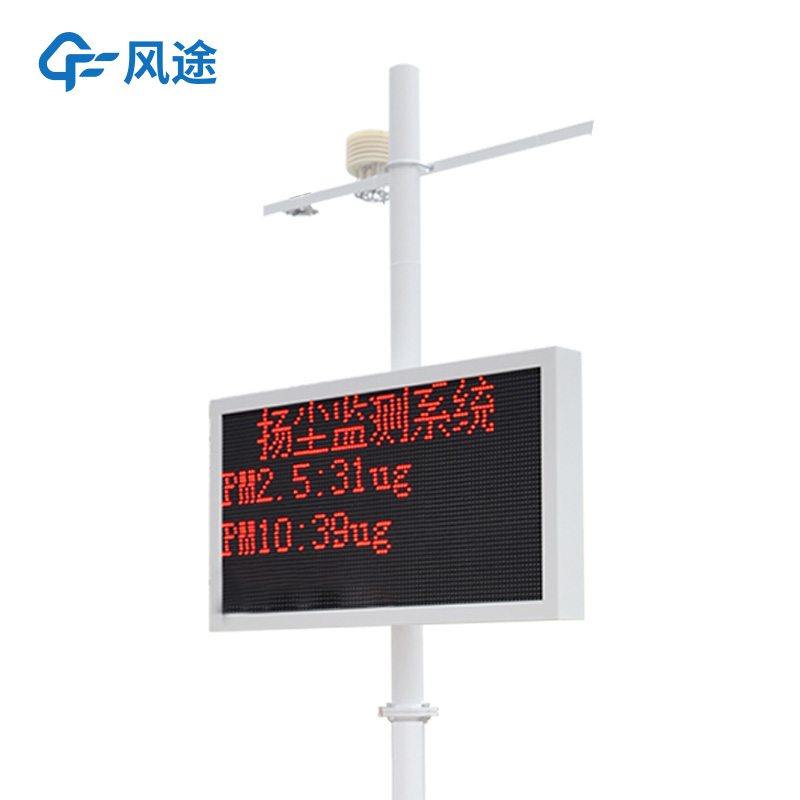
The development of dust detectors is closely related to environmental governance needs. As society's requirements for environmental governance continue to increase, PM2.5 has become an important indicator for environmental monitoring. Since fugitive dust is a significant component affecting PM2.5 levels, it has naturally become a key monitoring target for environmental protection departments. Traditional manual sampling and detection methods are inefficient and consume substantial human and material resources. Against this background, real-time monitoring dust detectors have emerged as important tools for environmental governance.
Dust detectors employ technical methods such as laser scattering to accurately monitor fugitive dust particles, offering fast response speeds and wide measurement ranges. These devices achieve 24/7 real-time continuous monitoring, updating data every minute, which greatly improves monitoring efficiency. The equipment integrates multiple monitoring functions, including environmental factors such as PM2.5, PM10, noise, temperature, humidity, wind speed, and wind direction, forming comprehensive monitoring capabilities. When monitoring data exceeds standard limits, the system can automatically send early warning information and can link with control equipment such as fog cannons and spray systems to achieve linkage between monitoring and control. Monitoring data is uploaded to management platforms in real-time through wireless transmission technology, supporting remote access and multi-terminal viewing to provide timely basis for management decisions.
Dust detectors are widely used in dust-sensitive areas such as construction sites, mining ports, industrial parks, and urban roads. Through real-time monitoring, they effectively enhance the intensity and level of environmental supervision. These devices not only provide reliable supervision tools for environmental protection departments but also can link with pollution control devices to achieve automatic control, promoting the transformation of environmental governance from passive management to active prevention and control. Ultimately, they form a trinity governance model consisting of pollution source self-inspection, public supervision, and government management.
This paper addresses:https://www.fengtuweather.com/industry/818.html
Related products
Related article
-
EL Test Power Supply provides 0 to 1500V DC output
2026-05-20 -
How Photovoltaic Solar Environmental Monitoring System Empowers Fishery-Photovoltaic Complementation
2024-12-16 -
Ground Penetrating Radar: Non-Destructive Precision Detection for Voids Beneath Building Floors
2025-07-17 -
Fengtu Automated Weather Monitoring for the Modern Farm
2024-08-13 -
Enhancing Convalescent Care Through Negative Oxygen Ion Concentration Monitoring
2025-05-21 -
What are the advantages of the 12 metre manual pre-dischargeable lightning rod?
2024-05-28 -
Dust monitoring system improves supervision
2024-06-12 -
Six-Element Weather Station: Precise Monitoring of Basic Meteorological Elements, Adaptable to Multiple Industries
2026-03-03