

Product
-
Weather station
-
Road Weather Station
-
Photovoltaic Inspection
-
Atmospheric monitoring
-
Operating condition monitoring
Recommended article
- Electrical Power Analyzer enables multi-channel power grid parameter acquisition and the detection of harmonics and unbalance
- Shandong Fengtu, a manufacturer of meteorological stations, offers high-precision weather observation equipment designed for field use
- Series power supply for EL-Based Internal Defect Detection in Photovoltaic Modules
- Shandong Fengtu, a manufacturer of meteorological monitoring instruments, produces advanced weather observation equipment
- Odor gas detector On-site Monitoring of Odorous Pollutants in Compliance with the GB14554 Standard
- Integrated Four-Parameter Weather Station for Field Meteorological Data Collection (Temperature, Humidity, Wind Speed, and Wind Direction)
Contact us
Shandong Fengtu IOT Technology Co., Ltd
Sales Manager:Ms. Emily Wang
Cel,Whatsapp,Wechat:+86 15898932201
Email:info@fengtutec.com
Add:No. 155 Optoelectronic Industry Accelerator, Gaoxin District, Weifang, Shandong, China
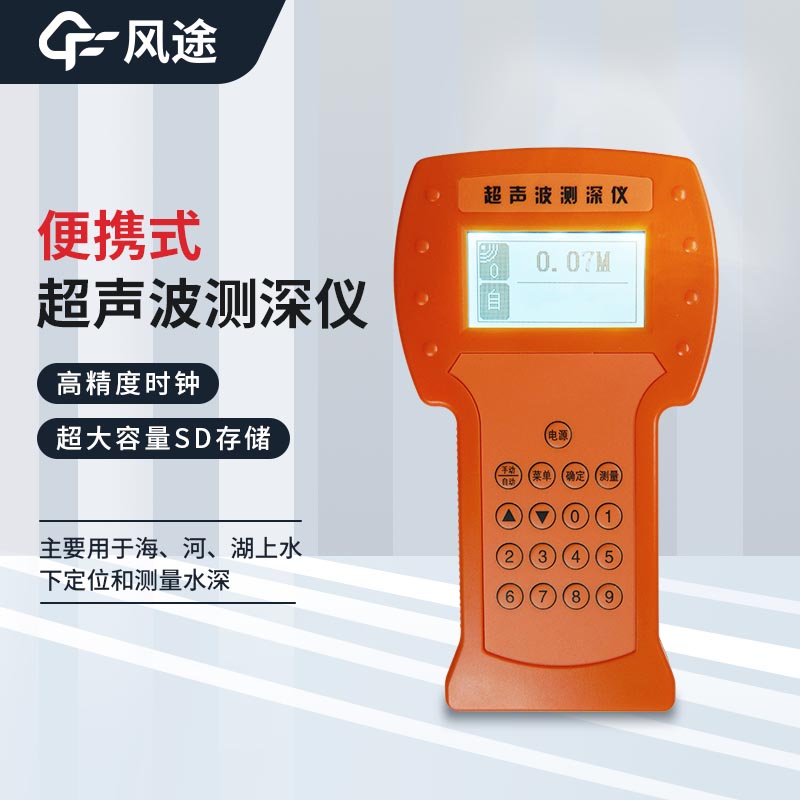
The Advantages of Portable Ultrasonic Water Depth Meter in Water Temperature and Depth Detection
Article source:Weather station time:2025-05-13 09:10:26 viewed:612times
Water temperature and water depth are important parameters for studying the water body environment, and there are various detection methods. In the early stage, glass thermometers were often used to measure water temperature. The thermometer is immersed in water, and the scale value is read after the liquid column stabilizes. For water depth measurement, sounding ropes are mostly used. Marks are made on the rope, and the rope is manually submerged to the bottom of the water, and the water depth is determined according to the length of the rope immersed in water. However, these methods are inefficient and have large errors, and it is difficult to meet the measurement requirements in complex environments.
With the development of science and technology, the Portable Ultrasonic Water Depth Meter has gradually become the mainstream measurement tool. When detecting water temperature, the built-in temperature sensor is used to collect water body temperature data. Generally, thermistors are used as temperature sensors. Changes in temperature will cause changes in the resistance value, and the instrument calculates the real-time water temperature accordingly.
The principle of the Portable Ultrasonic Water Depth Meter for detecting water depth is based on the propagation characteristics of ultrasonic waves in water. The instrument emits ultrasonic pulses to the bottom of the water, and the sound waves propagate at a fixed speed in water and are reflected back to the instrument after hitting the bottom of the water. By accurately measuring the time from the emission to the reception of ultrasonic waves, and combining with the propagation speed of sound waves in water, using the formula "water depth = sound speed × propagation time ÷ 2", the water body depth can be calculated. Since the propagation speed of ultrasonic waves is affected by water temperature, the instrument will automatically correct the sound speed value according to the real-time measured water temperature data to ensure the accuracy of water depth measurement.
Compared with traditional methods, the Portable Ultrasonic Water Depth Meter has more advantages. It can achieve rapid and continuous measurement, is not affected by the turbidity of the water body, and can work stably in harsh environments.
This paper addresses:https://www.fengtuweather.com/industry/699.html
Related products
Related article
-
What is a smart river management system?
2024-06-20 -
Dust monitoring system for in-depth environmental protection
2024-02-20 -
Road Weather Station: Real-Time Monitoring and Early Warning for Safe Traffic Operations
2025-06-05 -
Fengtu Road Weather Station
2025-05-28 -
Fengtu Small Automatic Weather Station: Integrated Monitoring for Timely Meteorological Insights
2025-07-10 -
Real-time data from the road meteorological monitoring system supports traffic early warning
2026-06-01 -
The price of fully automatic mini weather stations varies from 3900 to 9800 yuan depending on the number of monitored parameters
2026-05-15 -
Meteorological observation station Simultaneously Monitors Six Meteorological Parameters
2026-04-15