

Product
-
Weather station
-
Road Weather Station
-
Photovoltaic Inspection
-
Atmospheric monitoring
-
Operating condition monitoring
Recommended article
- Electrical Power Analyzer enables multi-channel power grid parameter acquisition and the detection of harmonics and unbalance
- Shandong Fengtu, a manufacturer of meteorological stations, offers high-precision weather observation equipment designed for field use
- Series power supply for EL-Based Internal Defect Detection in Photovoltaic Modules
- Shandong Fengtu, a manufacturer of meteorological monitoring instruments, produces advanced weather observation equipment
- Odor gas detector On-site Monitoring of Odorous Pollutants in Compliance with the GB14554 Standard
- Integrated Four-Parameter Weather Station for Field Meteorological Data Collection (Temperature, Humidity, Wind Speed, and Wind Direction)
Contact us
Shandong Fengtu IOT Technology Co., Ltd
Sales Manager:Ms. Emily Wang
Cel,Whatsapp,Wechat:+86 15898932201
Email:info@fengtutec.com
Add:No. 155 Optoelectronic Industry Accelerator, Gaoxin District, Weifang, Shandong, China
Dust Monitoring Equipment: Technology, Applications, and Contributions to Air Pollution Control
Article source:Weather station time:2025-10-29 09:24:39 viewed:663times
With the rapid development of global industrialization and urbanization, fugitive dust has become one of the major sources of air pollution. According to research, dust accounts for as high as 28% of pollution sources, among which unorganized pollution sources such as road dust, construction dust, and stockyard dust are difficult to control. To address this issue, governments around the world have introduced environmental protection policies, such as China's "Air Pollution Prevention and Control Action Plan" and the European Union's "Air Quality Directive," driving the demand for dust monitoring equipment.
Traditional dust monitoring methods have limitations including long monitoring cycles, data lag, and inability to provide real-time alarms, making it difficult to meet modern environmental regulatory needs. Against this background, Dust Monitoring Equipment combining sensor technology with IoT communication emerged, achieving a transformation from passive management to active monitoring.
The core of Dust Monitoring Equipment lies in particulate matter concentration monitoring technology, mainly adopting the laser scattering method. When light irradiates particles suspended in the air, scattered light is produced. Under certain conditions of optical system and dust properties, the scattered light intensity is proportional to the dust concentration. This method features fast response speed and wide measurement range, making it suitable for real-time monitoring.
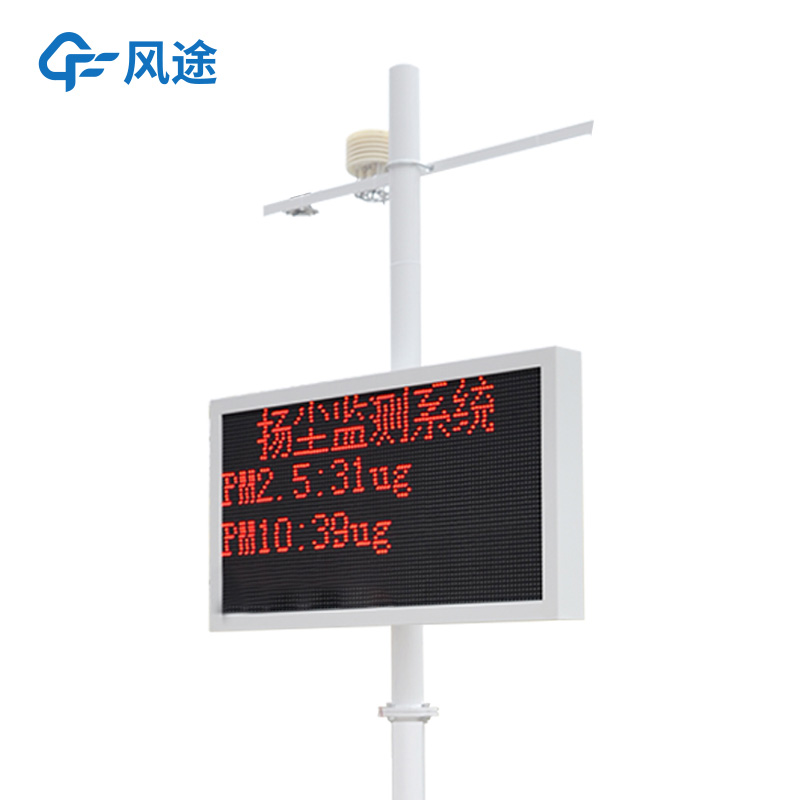
These monitoring devices can not only measure concentrations of particulate matter such as PM2.5 and PM10 but also integrate multiple sensors for temperature, humidity, wind speed, wind direction, noise, etc., forming comprehensive environmental monitoring capabilities.
These devices transmit collected data to the central data platform in real-time through 4G/3G wireless networks or wired connections, enabling remote monitoring and data management. Monitoring data can be accessed through multiple terminals including PC, mobile devices, and LED displays, facilitating managers to grasp environmental quality conditions in real-time.
Currently, Dust Monitoring Equipment has been widely applied in construction sites, road construction, ports, industrial parks and other locations, effectively solving the monitoring challenges of unorganized dust pollution sources. Through real-time monitoring and over-limit alarms, regulatory authorities can promptly grasp dust pollution conditions and prompt relevant units to take dust suppression measures.
It can also be linked with fog cannons and spray systems to achieve intelligent management of immediate pollution treatment upon detection, significantly improving the efficiency and precision of dust pollution control.
This paper addresses:https://www.fengtuweather.com/industry/822.html
Related products
Related article
-
How to choose a dust and noise monitor?
2024-07-16 -
Scenic anion weather monitoring system core function
2024-08-07 -
The price of small weather stations varies depending on their model and configuration
2026-08-06 -
Negative oxygen ion monitoring system to protect the scenic environment
2024-03-22 -
Forest Fire Detection Improves Forest Fire Early Warning and Suppression Efficiency by Relying on Meteorological Factor Data
2026-05-26 -
Hand-operated lifting bar lightning rod with flexible design
2024-02-18 -
Small meteorological monitoring stations for agriculture
2024-07-09 -
Fengtu Technology: Providing Reliable Online dust Monitoring system Solutions for Smart Environmental Management
2025-11-14