

Product
-
Weather station
-
Road Weather Station
-
Photovoltaic Inspection
-
Atmospheric monitoring
-
Operating condition monitoring
Recommended article
- Electrical Power Analyzer enables multi-channel power grid parameter acquisition and the detection of harmonics and unbalance
- Shandong Fengtu, a manufacturer of meteorological stations, offers high-precision weather observation equipment designed for field use
- Series power supply for EL-Based Internal Defect Detection in Photovoltaic Modules
- Shandong Fengtu, a manufacturer of meteorological monitoring instruments, produces advanced weather observation equipment
- Odor gas detector On-site Monitoring of Odorous Pollutants in Compliance with the GB14554 Standard
- Integrated Four-Parameter Weather Station for Field Meteorological Data Collection (Temperature, Humidity, Wind Speed, and Wind Direction)
Contact us
Shandong Fengtu IOT Technology Co., Ltd
Sales Manager:Ms. Emily Wang
Cel,Whatsapp,Wechat:+86 15898932201
Email:info@fengtutec.com
Add:No. 155 Optoelectronic Industry Accelerator, Gaoxin District, Weifang, Shandong, China
Are field microclimate observatories useful?
Article source:Weather station time:2024-04-15 09:12:12 viewed:554times
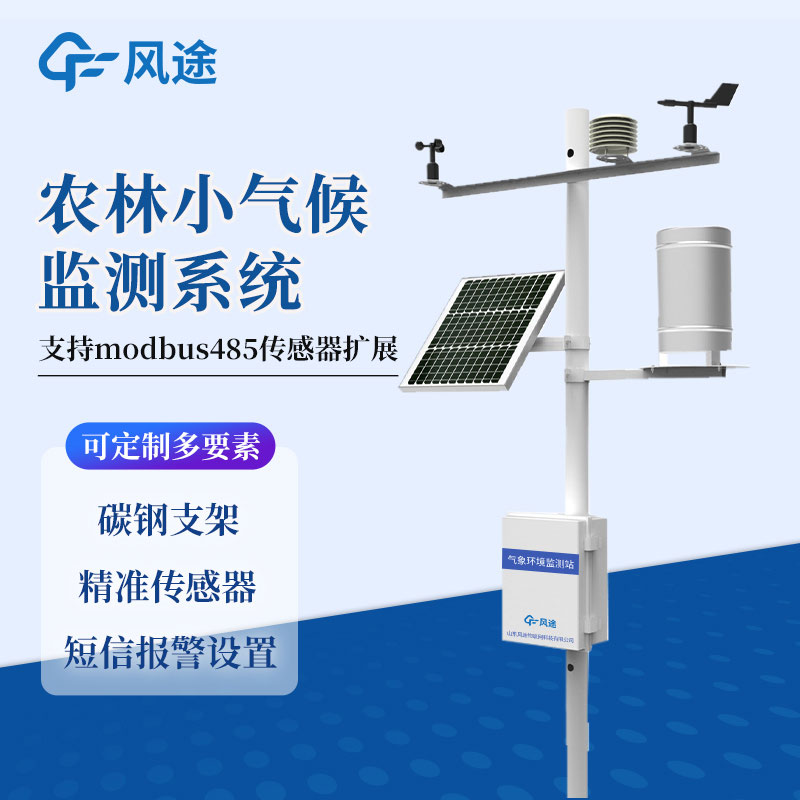
Meteorological stations play an important role in agricultural production by providing critical information needed for agricultural planning and crop planting arrangements. Crops depend on favourable climatic conditions, such as temperature, humidity, light and water. Through the continuous monitoring and data recording of these elements by agrometeorological stations, agricultural producers can better plan and adjust their production activities, thereby enhancing the efficiency and economic benefits of agricultural production. Data from weather stations help ensure that crops can thrive under optimal growing conditions, leading to abundant output and profitability.
In recent years, the use of field microclimate stations in field management has become more common as the agricultural farming industry continues to progress. The main function of these weather stations is to monitor various meteorological conditions on farmland in real time, including temperature, humidity, wind speed, wind direction, precipitation and light intensity. By collecting these key data, agro-weather stations help farmers understand more accurately the environmental conditions under which their crops grow, so that they can make more reasonable planting decisions, optimise the allocation of agricultural resources, and improve crop yields and quality. The application of such scientific and technological means is of great significance in enhancing the science and accuracy of agricultural production.
The field microclimate observatory collects meteorological information such as temperature and humidity in real time through the installed meteorological sensors. These data are collected by the collector and sent to the management platform through a wireless network. Users can access these data directly on their computers, facilitating real-time monitoring and analysing of farmland climate conditions.
In modern agriculture, weather stations are able to operate automatically under unattended conditions and adapt to a variety of terrains and environments, which significantly extends the coverage of weather monitoring and improves the accuracy and credibility of the data.
This paper addresses:https://www.fengtuweather.com/industry/335.html
Related products


Related article
-
Vehicle - Mount Weather Stations: Applications and Advantages
2024-11-11 -
Fire Risk Factor Integrated Monitoring Station Instructions
2024-07-03 -
Functions of automatic meteorological monitoring station for field microclimate
2024-07-25 -
The Hazards of Airborne Particulate Matter (PM) and the Role of PM2.5 Air Quality Monitor
2024-11-14 -
Fengtu Technology's Visibility Detection Systems: Enhancing Traffic Safety on Highways
2025-10-20 -
Six-Element Automatic Weather Station is Adaptable to High-Precision Meteorological Monitoring Applications Across Multiple Scenarios
2026-09-04 -
Negative Oxygen Ion Monitoring Equipment Visualising Current Negative Ion Levels
2024-04-11 -
Fog and Visibility Monitoring Technology
2025-11-03