

Product
-
Weather station
-
Road Weather Station
-
Photovoltaic Inspection
-
Atmospheric monitoring
-
Operating condition monitoring
Recommended article
- Electrical Power Analyzer enables multi-channel power grid parameter acquisition and the detection of harmonics and unbalance
- Shandong Fengtu, a manufacturer of meteorological stations, offers high-precision weather observation equipment designed for field use
- Series power supply for EL-Based Internal Defect Detection in Photovoltaic Modules
- Shandong Fengtu, a manufacturer of meteorological monitoring instruments, produces advanced weather observation equipment
- Odor gas detector On-site Monitoring of Odorous Pollutants in Compliance with the GB14554 Standard
- Integrated Four-Parameter Weather Station for Field Meteorological Data Collection (Temperature, Humidity, Wind Speed, and Wind Direction)
Contact us
Shandong Fengtu IOT Technology Co., Ltd
Sales Manager:Ms. Emily Wang
Cel,Whatsapp,Wechat:+86 15898932201
Email:info@fengtutec.com
Add:No. 155 Optoelectronic Industry Accelerator, Gaoxin District, Weifang, Shandong, China
Principle of Light Scattering Dust Detector
Article source:Weather station time:2024-05-27 08:44:34 viewed:548times
As one of the main sources of air pollution, the control and management of dust occupies a pivotal position in urban environmental protection. At present, the prevention and control of urban dust pollution faces three major challenges: firstly, construction sites and other major sources of dust emissions are in urgent need of all-weather close monitoring; secondly, due to the large number of monitoring points and geographic dispersion, coupled with insufficient staffing, it is difficult to comprehensively cover the monitoring work; lastly, the phenomenon of serious information silos leads to a cumbersome process of governance, high cost of collaborative operations, and difficult to sustain the effectiveness of the governance.
As a key area of air pollution control, the management of dust pollution is of vital importance. Real-time online monitoring of dust pollution at construction sites, industrial plants, urban areas and residential living areas is a key measure to achieve effective control of particulate matter concentrations and minimise the impact of dust pollution. Through this means of monitoring, the negative impact of dust on air quality can be significantly reduced, which in turn promotes the improvement of air environment quality.
When light strikes suspended particles in the air, light scattering occurs. Dust monitors utilise this principle to make accurate measurements by capturing information such as the intensity and frequency of the scattered light. The built-in algorithm of the monitor analyses and calculates these data comprehensively, and finally converts the result into the concentration value of particles in the air.
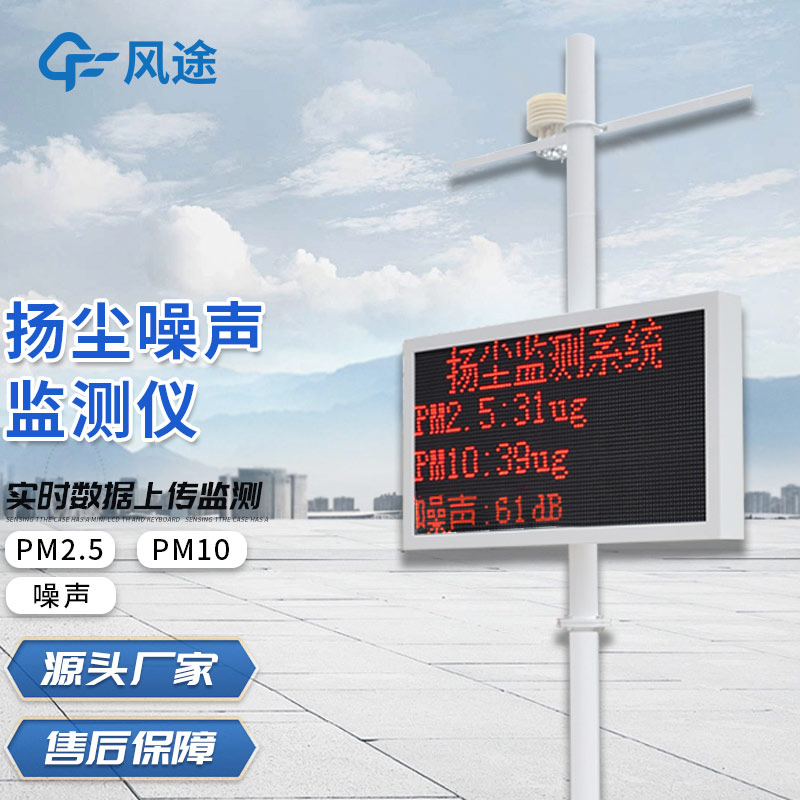
The dust monitoring terminal launched by Fengtu not only has the function of monitoring PM2.5, PM10 and TSP particulate matter, but also can be extended through modularisation to integrate a variety of monitoring equipment such as meteorological monitoring, noise monitoring, video surveillance, LED display and alarm lights. This system is capable of real-time automatic monitoring of key environmental parameters such as noise, ambient temperature, humidity, wind speed and direction, building a comprehensive monitoring solution for unorganised emissions.
This paper addresses:https://www.fengtuweather.com/industry/384.html
Related products
Related article
-
Data-Driven Stewardship: The FT-CQX9 Grassland ecological monitoring station for Grassland Protection and Sustainable Livestock Farming
2025-11-13 -
What is the best Farmland Weather Station manufacturer?
2024-08-28 -
photovoltaic testers is designed for high-precision testing at large-scale photovoltaic (PV) power plants
2026-09-11 -
Real-Time Dust Monitoring: How Dust Detectors Protect Public Health and the Environment
2025-05-15 -
Meteorological monitoring system meteorological monitors
2024-06-21 -
Vehicle-Mount Weather Station: Mobile Meteorological Monitoring for Vehicle Environmental Testing
2025-07-14 -
Price Variations in Six-Element Weather Stations: Driven by Sensor Principles and Configuration Requirements
2026-05-09 -
Odor gas detector is used for precise odor monitoring in multiple scenarios
2026-03-04