

Product
-
Weather station
-
Road Weather Station
-
Photovoltaic Inspection
-
Atmospheric monitoring
-
Operating condition monitoring
Recommended article
- Electrical Power Analyzer enables multi-channel power grid parameter acquisition and the detection of harmonics and unbalance
- Shandong Fengtu, a manufacturer of meteorological stations, offers high-precision weather observation equipment designed for field use
- Series power supply for EL-Based Internal Defect Detection in Photovoltaic Modules
- Shandong Fengtu, a manufacturer of meteorological monitoring instruments, produces advanced weather observation equipment
- Odor gas detector On-site Monitoring of Odorous Pollutants in Compliance with the GB14554 Standard
- Integrated Four-Parameter Weather Station for Field Meteorological Data Collection (Temperature, Humidity, Wind Speed, and Wind Direction)
Contact us
Shandong Fengtu IOT Technology Co., Ltd
Sales Manager:Ms. Emily Wang
Cel,Whatsapp,Wechat:+86 15898932201
Email:info@fengtutec.com
Add:No. 155 Optoelectronic Industry Accelerator, Gaoxin District, Weifang, Shandong, China
What are air quality monitoring stations?
Article source:Weather station time:2024-06-06 08:51:06 viewed:515times
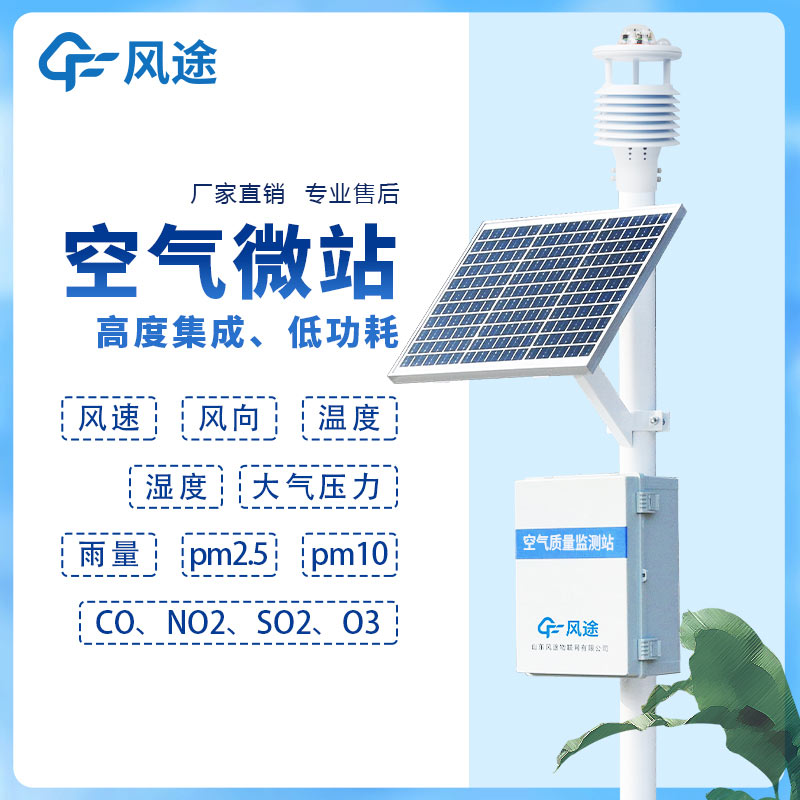
Air quality monitoring stations, often referred to simply as air stations, have the primary task of monitoring the atmosphere and airborne pollutants. These stations are capable of collecting, measuring and analysing harmful substances in the air on a regular, continuous or timed basis.
In order to monitor air quality comprehensively, environmentally focused cities usually deploy multiple air stations. Each station is equipped with multi-parameter monitoring instruments capable of automatic continuous monitoring. These instruments automatically record monitoring data and provide critical environmental data through real-time analyses.
The establishment and operation of air stations provide important air quality information to environmental protection authorities, helping them to keep abreast of the pollution situation, assess air quality and take necessary measures to improve and protect the environment.
Given the vast geographical area of the country and the limitations of fixed monitoring sites, standard and small monitoring stations are inadequate for comprehensive monitoring of air quality in small areas. At the same time, the relatively high cost of setting up standard and small stations and the economic pressure to achieve gridded air quality monitoring have led to the emergence of gridded micro air monitoring stations.
Such micro-monitoring stations mainly use diffusive or pump-suction sampling methods and employ multi-sensor information fusion techniques for air quality analysis. A calibration system may also be integrated within the system to ensure data accuracy. Compared to large monitoring sites, micro-monitoring stations are more focused on capturing trends in air quality changes and perform an early warning function to help identify and respond to potential air quality problems in a timely manner.
This paper addresses:https://www.fengtuweather.com/industry/394.html
Related products

Related article
-
Vehicle-Mount Weather Station: Mobile Meteorological Monitoring for Vehicle Environmental Testing
2025-07-14 -
Road Weather Station & Matching Environmental Monitoring Cloud Platform: Monitoring, Early Warning and Traffic Safety Guarantee
2025-08-25 -
Forest fire weather station, fire prevention, observation of ecology
2024-04-01 -
Integrated Four-Parameter Weather Station for Field Meteorological Data Collection (Temperature, Humidity, Wind Speed, and Wind Direction)
2026-10-15 -
Recommend a weather monitoring equipment company
2024-06-26 -
Photovoltaic module efficiency testing equipment Provides High-Voltage, High-Power Performance Testing Solutions
2026-01-04 -
Compliant and Comprehensive: Fengtu's Online Dust Particle Counter for Electronic Cleanrooms
2025-07-11 -
Automated systems for meteorological stations
2024-04-18