

Product
-
Weather station
-
Road Weather Station
-
Photovoltaic Inspection
-
Atmospheric monitoring
-
Operating condition monitoring
Recommended article
- Electrical Power Analyzer enables multi-channel power grid parameter acquisition and the detection of harmonics and unbalance
- Shandong Fengtu, a manufacturer of meteorological stations, offers high-precision weather observation equipment designed for field use
- Series power supply for EL-Based Internal Defect Detection in Photovoltaic Modules
- Shandong Fengtu, a manufacturer of meteorological monitoring instruments, produces advanced weather observation equipment
- Odor gas detector On-site Monitoring of Odorous Pollutants in Compliance with the GB14554 Standard
- Integrated Four-Parameter Weather Station for Field Meteorological Data Collection (Temperature, Humidity, Wind Speed, and Wind Direction)
Contact us
Shandong Fengtu IOT Technology Co., Ltd
Sales Manager:Ms. Emily Wang
Cel,Whatsapp,Wechat:+86 15898932201
Email:info@fengtutec.com
Add:No. 155 Optoelectronic Industry Accelerator, Gaoxin District, Weifang, Shandong, China
How many parameters can a park anion monitoring system measure?
Article source:Weather station time:2024-07-24 08:43:36 viewed:556times
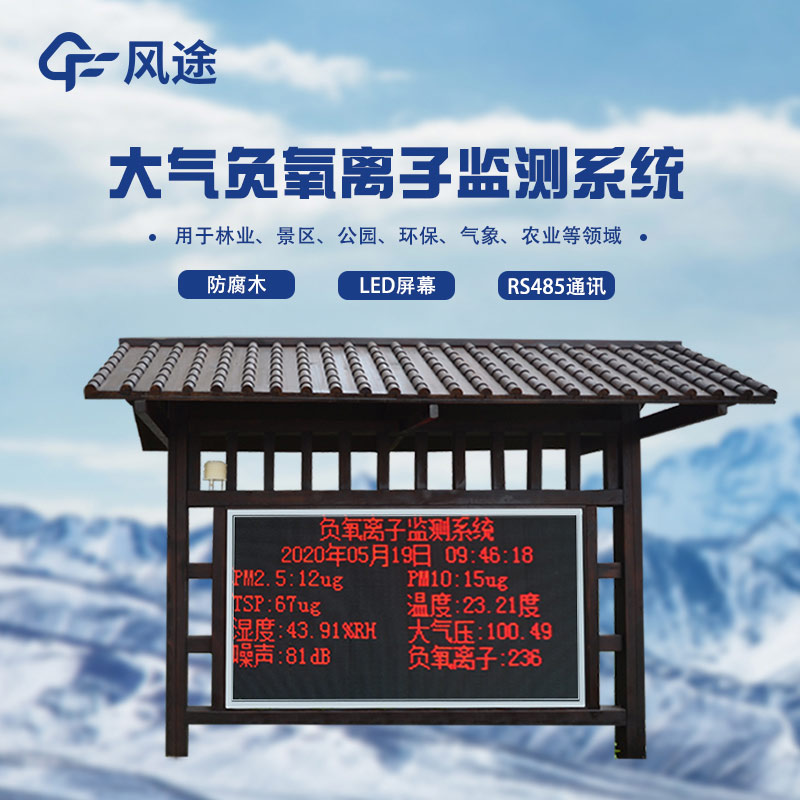
When we go to the park to play, we can always see a big electronic screen at the entrance, which shows the latest air quality data, do you know where these data come from?
It is known that the above equipment is a device called "Negative Oxygen Ion Monitoring System". This system is developed for monitoring meteorological data in scenic spots and places of interest. With this device, managers of scenic spots and tourists can get accurate information about weather conditions. It can monitor the following parameters:
1. Air pollutants
PM2.5 and PM10: represent particles with diameters less than or equal to 2.5 micrometers and 10 micrometers, respectively. These fine particles can be suspended in the air for a longer period of time, which has a greater impact on human health.
Sulfur dioxide (SO2): a common air pollutant, mainly from coal combustion and industrial emissions.
Nitrogen Dioxide (NO2): usually produced by transportation and industrial activities.
Carbon Monoxide (CO): a colorless, odorless gas, mainly from incomplete combustion.
Ozone (O3): At the ground level, ozone is a harmful gas usually formed by the reaction of sunlight with other chemicals in the air.
2、Meteorological Parameters
Temperature: Monitors the real-time temperature of the scenic area, reflecting the current level of thermal comfort.
Humidity: Measures the amount of water vapor in the air, which affects human comfort and evaporative cooling efficiency.
Wind Speed and Direction: Records the speed and direction of the wind, which is crucial for outdoor activities and safety management of scenic spots.
Barometric pressure: reflects the level of atmospheric pressure, which is closely related to weather changes.
Precipitation: Measures the amount of rainfall, which is instructive for water resource management and visitor planning.
Ultraviolet index: assesses the intensity of ultraviolet radiation, which is suggestive for visitors' health protection.
The meteorological monitoring system at the scenic spot provides visitors with real-time weather information to help them plan their trips, as well as helping scenic spot managers to predict weather changes and improve their ability to cope with extreme weather. This not only ensures the safety of tourists, but also allows them to enjoy a better tour experience.
This paper addresses:https://www.fengtuweather.com/industry/441.html
Related products
Related article
-
Power Quality Analyzers is a portable electrical power detection device
2026-03-13 -
Odor Monitoring System achieves 24-hour gas concentration monitoring through a multi-sensor array
2026-05-14 -
Real-Time Dust Monitoring: How Dust Detectors Protect Public Health and the Environment
2025-05-15 -
There are two types of handheld meteorological instruments
2024-01-29 -
Reducing Accident Risk with Road Weather Stations
2024-09-04 -
Dust Detector: Key to Monitoring and Mitigating TSP, PM2.5 and PM10 at Construction Sites
2025-05-09 -
FT - CZ5SVehicle - Mount Weather Station: Uniting Surveillance and Mobility for Environmental Monitoring
2025-04-15 -
What are the four conditions of agricultural monitoring?
2024-02-26