

Product
-
Weather station
-
Road Weather Station
-
Photovoltaic Inspection
-
Atmospheric monitoring
-
Operating condition monitoring
Recommended article
- Electrical Power Analyzer enables multi-channel power grid parameter acquisition and the detection of harmonics and unbalance
- Shandong Fengtu, a manufacturer of meteorological stations, offers high-precision weather observation equipment designed for field use
- Series power supply for EL-Based Internal Defect Detection in Photovoltaic Modules
- Shandong Fengtu, a manufacturer of meteorological monitoring instruments, produces advanced weather observation equipment
- Odor gas detector On-site Monitoring of Odorous Pollutants in Compliance with the GB14554 Standard
- Integrated Four-Parameter Weather Station for Field Meteorological Data Collection (Temperature, Humidity, Wind Speed, and Wind Direction)
Contact us
Shandong Fengtu IOT Technology Co., Ltd
Sales Manager:Ms. Emily Wang
Cel,Whatsapp,Wechat:+86 15898932201
Email:info@fengtutec.com
Add:No. 155 Optoelectronic Industry Accelerator, Gaoxin District, Weifang, Shandong, China
Reducing Accident Risk with Road Weather Stations
Article source:Weather station time:2024-09-04 14:23:38 viewed:535times
Severe weather poses significant challenges to traffic safety, particularly in China. The safe and smooth operation of highways is crucial for the economy and the daily lives of citizens. In the face of high-impact weather conditions such as dense fog, patchy fog, and road icing, the importance of traffic meteorological services is highlighted.
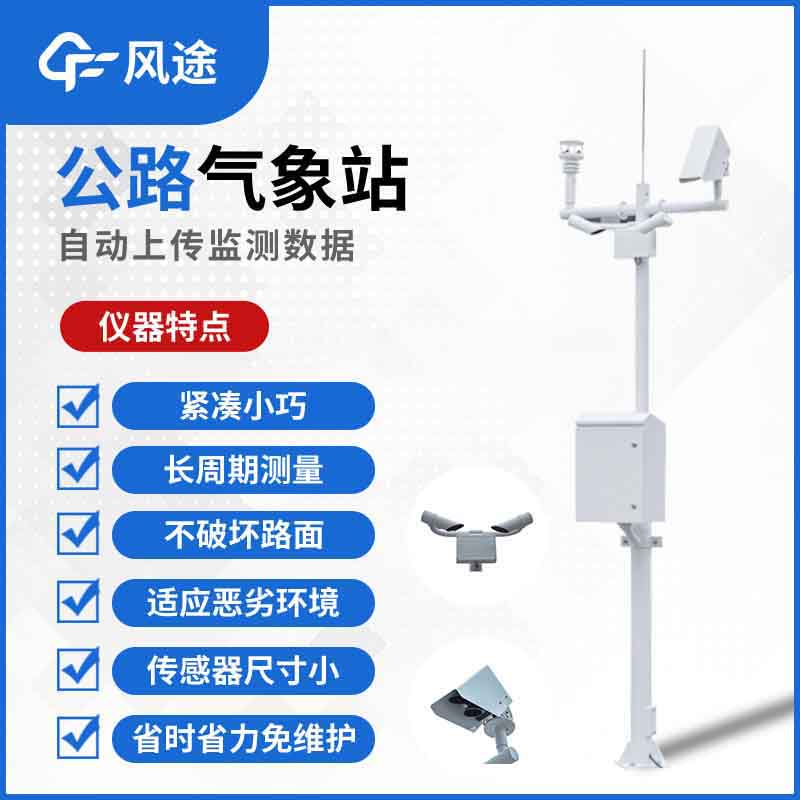
Road Weather Stations (RWS) feature highly integrated designs that simplify the processes of data collection, processing, and transmission, while also reducing manufacturing, installation, and maintenance costs, facilitating wider deployment and promoting service development.
RWS integrates automatic data collection, intelligent sensing, and wireless communication technologies to efficiently consolidate various meteorological sensors. These stations continuously gather meteorological data along the traffic routes, including CO2 concentration, air pressure, rainfall, wind speed, wind direction, light intensity, air temperature and humidity, soil temperature and humidity, as well as PM2.5 and PM10 levels, among other key meteorological elements. By monitoring in real-time and transmitting data remotely, these stations provide valuable raw data for traffic meteorological services.
To offer comprehensive traffic meteorological warnings and precise data, it is necessary to densely deploy monitoring points along the roads to collect meteorological data in real-time. These data should be combined with information from meteorological stations to analyze and predict weather changes.
This paper addresses:https://www.fengtuweather.com/industry/484.html
Related products
Related article
-
What is Weather Station, and what are its functions?
2025-11-28 -
Dust Monitoring Equipment: Real-Time Monitoring Solution for Fugitive Dust Pollution Management
2025-09-11 -
Dust Detector: Real-Time Data Transmission and 6 Core Functions for On-Site Environmental Control
2025-08-22 -
Vehicle-Mount Weather Station: A Mobile Solution for Wind Data Acquisition
2024-12-03 -
compact weather station Multi-Element Monitoring and Multi-Domain Applications
2026-01-26 -
Pavement Condition Detectors: Advantages of Laser Remote Sensing Technology
2024-07-19 -
Ultrasonic Snow Depth Detector Achieving Millimeter-Level Automatic Snow Depth Measurement Using Ultrasonic Ranging Principles
2026-03-19 -
What is an on-farm microclimate monitoring system?
2024-05-15