

Product
-
Weather station
-
Road Weather Station
-
Photovoltaic Inspection
-
Atmospheric monitoring
-
Operating condition monitoring
Recommended article
- Electrical Power Analyzer enables multi-channel power grid parameter acquisition and the detection of harmonics and unbalance
- Shandong Fengtu, a manufacturer of meteorological stations, offers high-precision weather observation equipment designed for field use
- Series power supply for EL-Based Internal Defect Detection in Photovoltaic Modules
- Shandong Fengtu, a manufacturer of meteorological monitoring instruments, produces advanced weather observation equipment
- Odor gas detector On-site Monitoring of Odorous Pollutants in Compliance with the GB14554 Standard
- Integrated Four-Parameter Weather Station for Field Meteorological Data Collection (Temperature, Humidity, Wind Speed, and Wind Direction)
Contact us
Shandong Fengtu IOT Technology Co., Ltd
Sales Manager:Ms. Emily Wang
Cel,Whatsapp,Wechat:+86 15898932201
Email:info@fengtutec.com
Add:No. 155 Optoelectronic Industry Accelerator, Gaoxin District, Weifang, Shandong, China
Dust Detector Systems: Comprehensive Environmental Monitoring for Effective Pollution Control
Article source:Weather station time:2025-09-25 09:35:42 viewed:543times
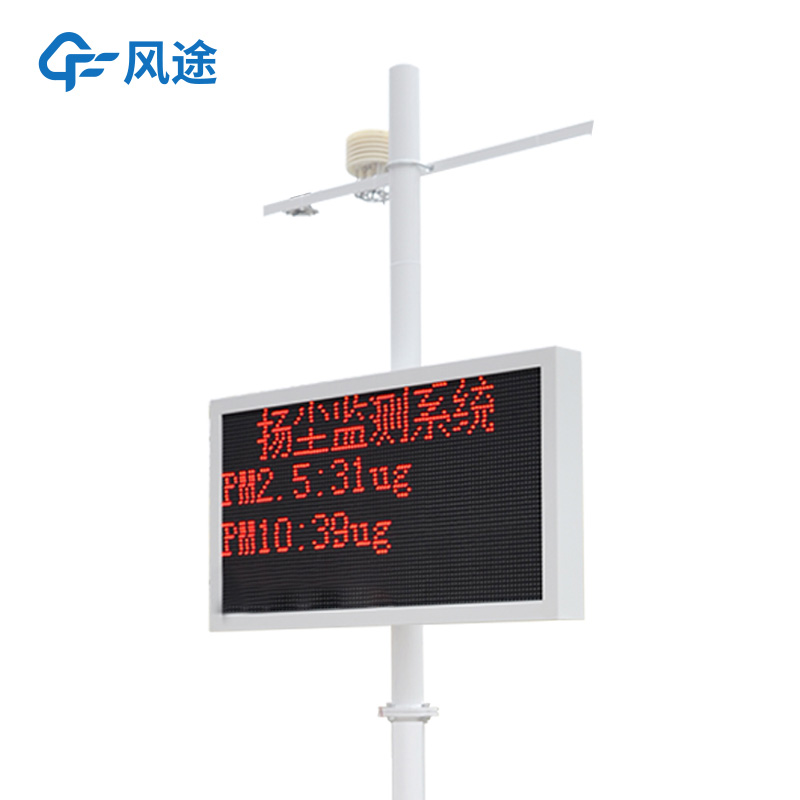
The Dust Detector integrates multiple sensors and functional modules to form a complete monitoring system. This system mainly consists of a dust monitoring unit, noise monitoring unit, meteorological monitoring unit, data acquisition and processing unit, data transmission unit, LED display unit, and video character overlay unit. It realizes real-time collection, processing, display, and transmission of environmental parameters, providing comprehensive data support for dust control.
The dust environment detector can monitor a wide range of environmental parameters, mainly including particulate matter concentration (PM2.5, PM10, TSP), noise intensity, meteorological elements (temperature, humidity, wind speed, wind direction), and atmospheric pressure. Comprehensive monitoring of multiple parameters helps to deeply analyze the sources and diffusion patterns of dust pollution, providing a basis for precise control. For example, by correlating wind speed and particulate matter concentration data, the impact range and direction of dust pollution can be determined, thereby adopting targeted dust suppression measures.
The architecture of the dust detection system can be divided into three layers: data acquisition layer, network transmission layer, and application layer. The data acquisition layer consists of various environmental sensors, monitoring hosts, display screens, brackets, and other hardware equipment, responsible for collecting raw data and on-site display; the network transmission layer uploads monitoring data to the environmental monitoring platform in real-time through wireless communication methods such as GPRS/4G; the application layer is responsible for data storage, analysis, and visualization, providing decision support for regulatory authorities. This layered architecture gives the system good flexibility and scalability, allowing flexible configuration according to the specific needs of different construction sites.
On one hand, it realizes 24-hour uninterrupted automatic monitoring, greatly improving monitoring efficiency and data quality; on the other hand, through wireless transmission technology, monitoring data can be uploaded to the management platform in real-time, facilitating remote monitoring and timely intervention by regulatory authorities.
The dust environment detector has a wide range of applications, mainly suitable for construction sites, demolition sites, coal mines, industrial parks, urban roads, and other places prone to dust pollution. With the improvement of environmental protection requirements and technological development, its application scenarios are constantly expanding, and it has now been gradually applied in mining, transportation, agricultural production, and other fields.
This paper addresses:https://www.fengtuweather.com/industry/801.html
Related products

Related article
-
What are air quality monitoring stations?
2024-06-06 -
Prairie Weather Stations Promote Data Sharing
2024-05-08 -
Ultrasonic Snow Depth Detectors: Enabling Accurate, 24/7 Snow Depth Monitoring for Meteorological and Traffic Sectors
2025-08-29 -
Road Weather Station & Matching Environmental Monitoring Cloud Platform: Monitoring, Early Warning and Traffic Safety Guarantee
2025-08-25 -
Natural Oxygen Bars in Scenic Spots: Negative Ion Monitoring for Healthy Tourism Development
2025-06-18 -
Dust Monitoring Equipment: Unifying Monitoring, Alert, and Pollution Mitigation
2025-04-28 -
Why install a snow depth monitoring station?
2024-01-25 -
Visibility sensor: Unlocking Precision in Atmospheric Visibility Measurement and Beyond
2024-11-25