

Product
-
Weather station
-
Road Weather Station
-
Photovoltaic Inspection
-
Atmospheric monitoring
-
Operating condition monitoring
Recommended article
- photovoltaic testers is designed for high-precision testing at large-scale photovoltaic (PV) power plants
- Meteorological observation station Field High-Precision Monitoring: Applications and Performance Advantages
- Power Quality Analyzers Precise Detection of Various Power Quality Issues in the Grid
- Mobile Monitoring Applications and Performance Advantages of Vehicle-Mounted Five-Parameter Meteorological Equipment
- Power Quality Monitoring Equipment Enables Precise Real-Time Monitoring of Multi-Dimensional Power Grid Parameters
- Six-Element Automatic Weather Station is Adaptable to High-Precision Meteorological Monitoring Applications Across Multiple Scenarios
Contact us
Shandong Fengtu IOT Technology Co., Ltd
Sales Manager:Ms. Emily Wang
Cel,Whatsapp,Wechat:+86 15898932201
Email:info@fengtutec.com
Add:No. 155 Optoelectronic Industry Accelerator, Gaoxin District, Weifang, Shandong, China
Handheld IV Testers Improve On-Site Testing Efficiency for Photovoltaic Power Plants
Article source:Weather station time:2026-06-16 13:31:02 viewed:116times
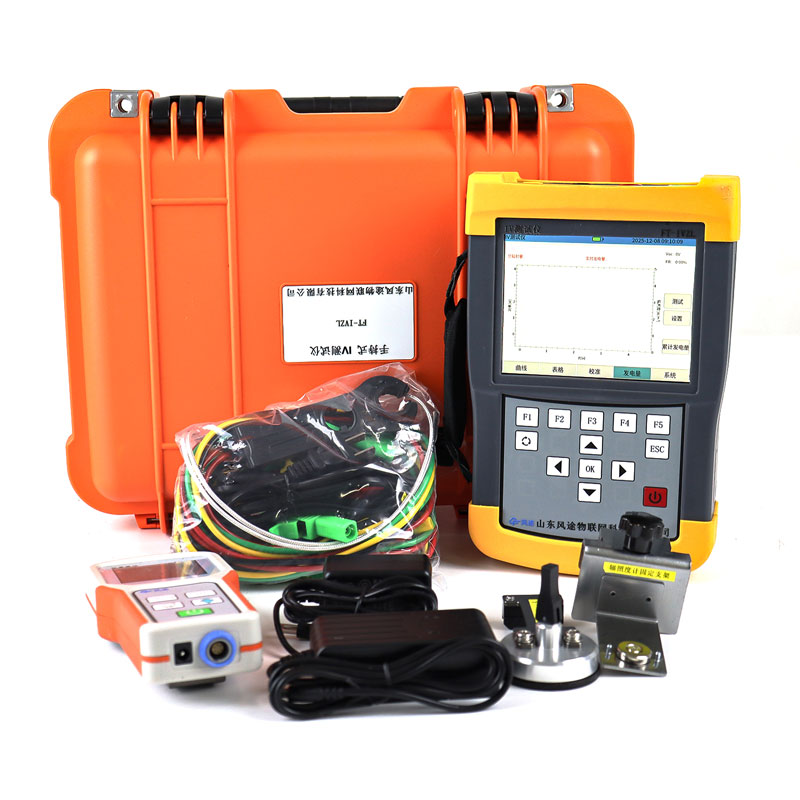
Handheld IV testers offer voltage testing up to 400V and current testing up to 20A, supporting testing of 1000W photovoltaic modules. They can measure parameters such as open-circuit voltage, short-circuit current, and maximum power. The device uses integrated packaging technology, has a clear user interface, and completes single-module testing in 10 seconds. It is equipped with a radiometer and temperature sensor.
The handheld IV tester is a portable device specifically designed for on-site performance testing of photovoltaic modules. By measuring the current output of photovoltaic modules under different voltage conditions, it plots current-voltage (IV) characteristic curves, visually presenting key parameters such as short-circuit current, open-circuit voltage, maximum power point, and fill factor. The device has a voltage testing range of up to 400V and a current testing capacity of up to 20A, covering the testing needs of photovoltaic modules up to 1000W.
In terms of hardware configuration, the handheld IV tester uses integrated packaging technology, making the entire unit compact and lightweight, supporting one-handed operation, and adaptable to complex outdoor environments such as high temperature, high humidity, and dust. The device incorporates a high-precision radiometer and temperature sensor, enabling simultaneous acquisition of on-site irradiance and solar panel temperature data during testing, providing accurate environmental parameters for subsequent data correction. Power is supplied by a high-capacity, replaceable lithium-ion battery, allowing for extended continuous testing on a single charge.
Operationally, the device features a dual-mode interface with a touchscreen and keyboard, providing clear and intuitive explanations. It utilizes a 4-wire connection for testing, featuring automatic range switching and overvoltage, overcurrent, and temperature protection mechanisms. Testing of a single module or string can be completed in just 10 seconds. The device includes a comprehensive database of solar cell module correction models, covering products from most module manufacturers. Test data can be instantly converted to values under Standard Test Conditions (STC), facilitating data comparison under different environmental conditions.
The handheld IV tester is equipped with a high-precision capacitive/resistive load and accompanying IV curve analysis software, enabling high-definition analysis of IV curves and supporting continuous, uninterrupted IV scanning. After testing, test data can be exported with a single click, stored in the device's internal memory, or exported to an external storage device via USB. This equipment is widely used in various scenarios, including routine operation and maintenance of photovoltaic power plants, random inspection of module quality, grid connection acceptance of projects, and third-party testing and certification. In power plant operation and maintenance, it can quickly diagnose the health status of modules and identify typical faults such as hot spots, microcracks, and power degradation. Its rapid, accurate, and comprehensive testing capabilities make it a common configuration for third-party testing agencies and power plant operation and maintenance personnel.
This paper addresses:https://www.fengtuweather.com/technical/957.html
Related products
Related article
-
Role of PV Weather Station in Real-Time Meteorological Monitoring for Photovoltaic Power Generation
2025-08-08 -
Odor Monitoring System is widely used in various odor pollution sources
2026-03-02 -
Police radar gun Achieves Vehicle-Mounted Dynamic Speed Measurement and Data Management Based on the Doppler Effect
2026-06-24 -
VOC monitor Technology and Applications
2025-11-19 -
Fengtu Technology: A Manufacturer of Compact Meteorological Equipment Offering a Full Range of Monitoring Products
2026-04-02 -
Laser snow depth monitor is applicable to snow depth observation in meteorology, traffic and disaster warning
2025-12-15 -
Ultrasonic Snow Depth Detector Achieving Millimeter-Level Automatic Snow Depth Measurement Using Ultrasonic Ranging Principles
2026-03-19 -
The role of weather stations in the forage industry
2024-02-28