

Product
-
Weather station
-
Road Weather Station
-
Photovoltaic Inspection
-
Atmospheric monitoring
-
Operating condition monitoring
Recommended article
- Electrical Power Analyzer enables multi-channel power grid parameter acquisition and the detection of harmonics and unbalance
- Shandong Fengtu, a manufacturer of meteorological stations, offers high-precision weather observation equipment designed for field use
- Series power supply for EL-Based Internal Defect Detection in Photovoltaic Modules
- Shandong Fengtu, a manufacturer of meteorological monitoring instruments, produces advanced weather observation equipment
- Odor gas detector On-site Monitoring of Odorous Pollutants in Compliance with the GB14554 Standard
- Integrated Four-Parameter Weather Station for Field Meteorological Data Collection (Temperature, Humidity, Wind Speed, and Wind Direction)
Contact us
Shandong Fengtu IOT Technology Co., Ltd
Sales Manager:Ms. Emily Wang
Cel,Whatsapp,Wechat:+86 15898932201
Email:info@fengtutec.com
Add:No. 155 Optoelectronic Industry Accelerator, Gaoxin District, Weifang, Shandong, China
The miniature weather station equipment outputs twelve monitoring data points simultaneously via a digital interface
Article source:Weather station time:2026-06-03 11:08:13 viewed:231times
The miniature weather station equipment adopts an integrated sensor design, integrating wind speed, wind direction, temperature and humidity, air pressure, optical rainfall, PM2.5/PM10, and six other gas monitoring modules into a single device. The equipment features rapid deployment without debugging, enabling continuous 24-hour online monitoring of outdoor meteorological parameters. It is suitable for emergency weather monitoring, mobile monitoring, and environmental grid-based deployment scenarios.
The miniature weather station equipment is changing the traditional deployment method of meteorological observation. Traditional weather stations require the separate installation of multiple independent instruments such as anemometers, wind vanes, temperature and humidity sensors, and rain gauges, which is time-consuming and requires professional debugging. The miniature weather station equipment, with its integrated sensor design, integrates all measurement modules into a single sensor, significantly reducing equipment size and installation complexity. The equipment supports wired, Bluetooth, and GPRS transmission methods, requires no debugging, and can be quickly deployed, making it suitable for acquiring meteorological data for various emergency short-term observations and mobile weather monitoring.
Regarding monitoring elements, some micro-weather station devices can perform real-time observations of twelve meteorological elements, including wind speed, wind direction, air temperature, humidity, atmospheric pressure, optical rainfall, PM2.5, PM10, CO, SO2, NO2, and O3. Wind speed measurement is based on ultrasonic principles, with a range of 0 to 60 m/s and a resolution of 0.1 m/s; wind direction measurement has a range of 0 to 360 degrees, an accuracy of ±2 degrees, and a resolution of 1 degree. Air temperature is measured using the diode junction voltage method, with a range of -40 to 80 degrees Celsius and an accuracy of ±0.3 degrees Celsius; humidity uses a capacitive sensor, with a range of 0 to 100%RH and an accuracy of ±3%RH. Atmospheric pressure measurement ranges from 300 to 1100 hPa, with an accuracy of ±0.25% and a resolution of 0.1 hPa. Optical rainfall measurement ranges from 0 to 4 mm/min, with an accuracy of ≤±4%. PM2.5 and PM10 measurement ranges from 0 to 1000 μg/m³, and carbon monoxide measurement ranges from 0 to 1000 ppm.
In terms of structural design, the concealed ultrasonic probe on the top cover is a key feature of the miniature weather station. Traditional anemometer probes are exposed, and rain, snow accumulation, and wind obstruction can affect measurement accuracy. The concealed top cover design hides the ultrasonic probe within the top housing of the sensor, avoiding interference from rain and snow accumulation and wind obstruction, thus ensuring the stability of the measurement data. The device uses continuously variable frequency ultrasonic signals to detect wind speed and direction by measuring the relative phase, eliminating the need for mechanical rotating parts and removing the starting wind speed limitations and mechanical wear problems of traditional cup anemometers. The sensor housing is made of imported ABS or ASA material, with a protection rating of IP65 or higher, effectively resisting corrosion from harsh environments such as salt spray. Optional features include a solar power system, a two-meter carbon steel or aluminum alloy bracket, a retractable design for easy carrying and transportation, and a shock-absorbing protective trolley case to enhance portability in field operations.
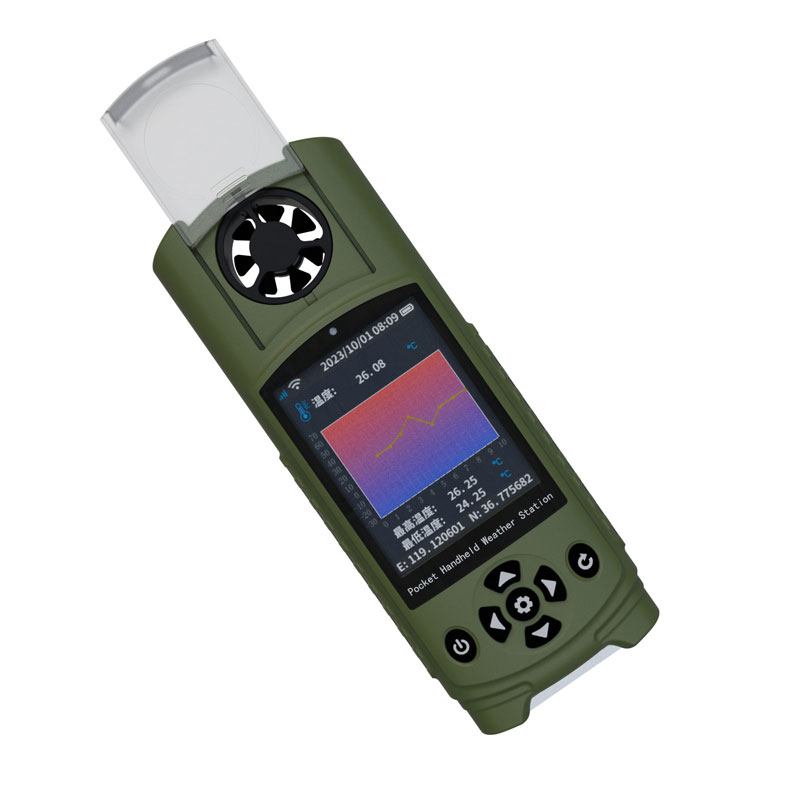
In terms of application scenarios, the miniature weather station equipment has been widely used in meteorology, agriculture and forestry, environmental protection, marine science, airports, ports, scientific research, and educational institutions. In emergency meteorological response, the equipment can be rapidly deployed to the site after a disaster, providing real-time meteorological data for rescue command and decision-making. In grid-based environmental monitoring, the equipment's small size and low power consumption allow for dense deployment within urban areas, enabling refined collection of microclimate data. In field research and investigation, the equipment's no-adjustment feature significantly lowers the barrier to entry for on-site operation, allowing even non-professionals to quickly complete deployment. Furthermore, some handheld mini weather station devices integrate GNSS tri-mode positioning technology, enabling real-time and accurate location information acquisition, suitable for mobile scenarios such as emergency rescue and outdoor operations. An external 4G module supports remote data viewing and analysis on a cloud platform. With the continuous maturation of IoT communication technology, the data upload interval of mini weather station devices can be adjustable from 1 minute to 1000 minutes, transmitting real-time monitoring data back to the monitoring center via various wireless network methods such as 4G/5G, LoRa, and NB-IoT, providing data support for refined meteorological monitoring in various industries.
This paper addresses:https://www.fengtuweather.com/technical/954.html
Related products

Related article
-
The Advantages of the Atmospheric Electric Field Meter in Thunderstorm Monitoring
2024-12-23 -
The Prominent Role of Fengtu's Road Weather Station in Transportation
2024-11-19 -
Portable & Efficient: Road Weather Information System for Traffic Sectors
2025-09-18 -
Application Introduction of Weather Monitoring Equipment High-Precision Environmental Monitoring Equipment in the Field
2026-08-21 -
What is a smart river management system?
2024-06-20 -
Portable Weather Station "Highlights"
2024-01-31 -
Automated Monitoring for Geological Disasters: Solutions for Hazard Point Detection and Early Warning
2025-06-13 -
photovoltaic testers Ideal for Photovoltaic System Testing and Cell Performance Assessment
2026-03-20