

Product
-
Weather station
-
Road Weather Station
-
Photovoltaic Inspection
-
Atmospheric monitoring
-
Operating condition monitoring
Recommended article
- Odor gas detector Enabling Precision, Round-the-Clock Monitoring of Fugitive Emissions in Industrial Facilities
- Compact Weather Stations: High-Precision Field Monitoring for Diverse Scenarios
- Shandong Fengtu, a renowned manufacturer of environmental monitoring instruments, supplies a wide range of field and online monitoring equipment
- Weather Monitoring Equipment enables high-precision, automated environmental parameter monitoring in field settings
- Introduction to the Principles, Applications, and Technical Specifications of Speed enforcement system
- Forest Weather Station Facilitates Precise Monitoring and Scientific Prevention of Forest Fires
Contact us
Shandong Fengtu IOT Technology Co., Ltd
Sales Manager:Ms. Emily Wang
Cel,Whatsapp,Wechat:+86 15898932201
Email:info@fengtutec.com
Add:No. 155 Optoelectronic Industry Accelerator, Gaoxin District, Weifang, Shandong, China
photovoltaic testers Ideal for Photovoltaic System Testing and Cell Performance Assessment
Article source:Weather station time:2026-03-20 10:10:47 viewed:362times
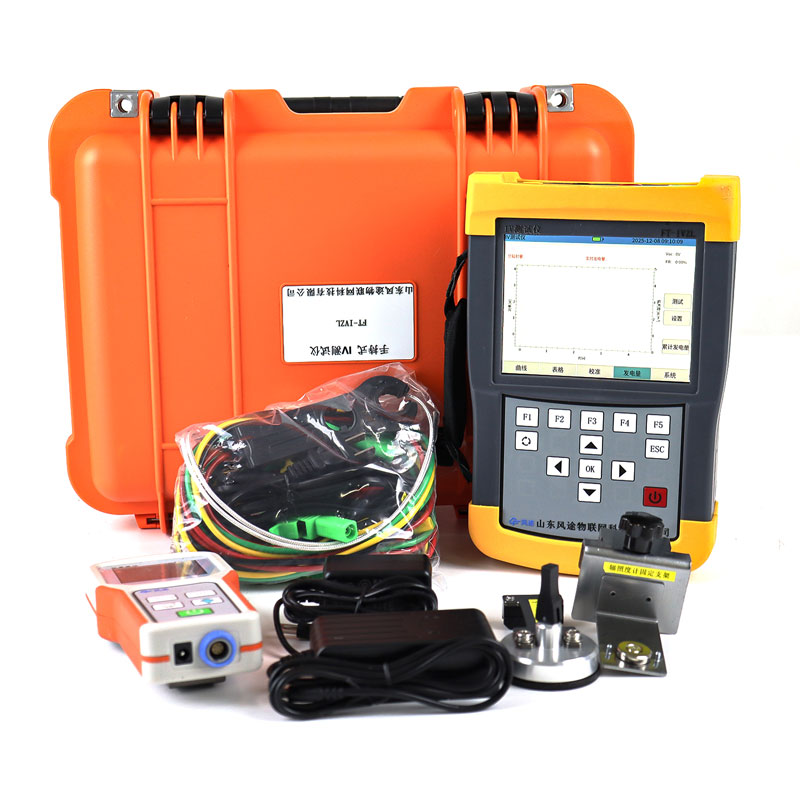
photovoltaic testers features a voltage test range extending up to 400V and a current test range up to 20A, enabling the testing of photovoltaic modules rated up to 1000W. The device is capable of measuring open-circuit voltage, short-circuit current, and maximum power, as well as plotting I-V curves. It supports the simultaneous measurement of irradiance and temperature, allowing test data to be converted to Standard Test Conditions (STC) values; this makes it an ideal tool for photovoltaic system inspection and solar cell performance evaluation.
photovoltaic testers is a high-precision, portable testing device specifically designed for photovoltaic power plants. With a voltage test capability reaching 400V and a current capability of 20A, it effectively meets the testing requirements for photovoltaic modules up to 1000W. The device is primarily used to measure key parameters—such as open-circuit voltage, short-circuit current, and maximum power—for individual solar modules and arrays. Furthermore, its I-V curve plotting function enables operations and maintenance personnel to gain a comprehensive understanding of a module's power generation performance.
In terms of testing functionality, the device measures a wide range of parameters—including short-circuit current, open-circuit voltage, maximum power, maximum power point voltage, and maximum power point current—while simultaneously displaying both I-V and P-V curves. Through its real-time testing feature, users can easily monitor the displayed open-circuit voltage values to quickly assess the operational status of a module. The device also incorporates a rapid short-circuit current testing function, allowing for quick on-site performance screening of modules and thereby enhancing testing efficiency.
The irradiance and temperature measurement functions constitute a key feature of this device. During the testing process, the irradiance incident on the solar module's surface and the temperature on the module's back panel are captured simultaneously, providing essential environmental context for analyzing the module's actual power output. An instant data conversion function allows test results to be translated into values corresponding to Standard Test Conditions (STC), thereby eliminating the influence of environmental factors on the results and facilitating direct comparative analysis of data collected at different times and locations.
Regarding data storage and management, the device supports saving test waveform data and test conditions to its internal memory; storage capacity can also be expanded via an external USB flash drive. Users can utilize a file copying function to directly transfer data files from the internal memory to a USB drive, enabling data export without the need to connect the device to a computer. Additionally, an intelligent battery indicator provides real-time monitoring of the device's remaining power level, preventing on-site testing operations from being interrupted due to insufficient battery charge. The built-in calibration database editing feature allows users to customize test calibration parameters according to their specific needs, thereby accommodating the varying precision requirements of different testing scenarios. The device's user interface is designed with a strong emphasis on field usability; the testing workflow is simple and intuitive, effectively reducing training costs.
In the field of PV system inspection, this device is applicable to various stages, including module site acceptance, routine power plant inspections, fault diagnosis, and power generation assessment. For both large-scale ground-mounted power plants and distributed rooftop systems, O&M personnel can utilize the photovoltaic testers to rapidly conduct spot checks on modules, identifying issues such as power degradation caused by hot spots, micro-cracks, or aging. Module manufacturers can also employ the device for factory spot checks and on-site after-sales testing to provide objective data regarding module performance.
The device features a portable design—compact and lightweight—making it ideal for a single operator to carry directly into a PV array site for field operations. Its wide measurement range of 400V/20A covers the testing requirements of current mainstream PV modules, including high-voltage, high-power bifacial modules. Test data can be exported to a computer for in-depth analysis and the generation of module performance trend curves, thereby supporting power plant asset management and O&M decision-making.
This paper addresses:https://www.fengtuweather.com/technical/897.html
Related products
Related article
-
What are the main classifications and common equipment of meteorological instruments?
2026-02-25 -
Three Portable Weather Stations, Only Better
2024-03-18 -
Road Weather Station: Monitoring, Warning, and Ensuring Road Safety
2025-02-05 -
Weather Instruments: Navigating Farms Through the Complexities of Climate for Bumper Crops
2025-02-18 -
Agricultural Monitoring System: Bridging Terminal Devices and Management Platform for Agriculture
2025-03-10 -
Vehicle-Mount Weather Station in Action: Tackling Meteorological Disasters Head-On
2024-12-05 -
Applications of Wind Speed Measuring Devices
2025-11-26 -
Laser snow depth monitor is applicable to snow depth observation in meteorology, traffic and disaster warning
2025-12-15