

Product
-
Weather station
-
Road Weather Station
-
Photovoltaic Inspection
-
Atmospheric monitoring
-
Operating condition monitoring
Recommended article
- How Meteorological Monitoring Stations for Photovoltaic (PV) Sites Achieve Simultaneous Output of Eight Parameters Without a "Starting Wind Speed" Threshold
- How Micro-Weather Stations Achieve Integrated Monitoring of Twelve Meteorological Parameters
- photovoltaic testers – On-site I-V Characteristic Testing for PV Modules and Strings
- Field weather stations provide stable collection and transmission of various atmospheric and environmental monitoring parameters
- Portable I-V Power Tester for Photovoltaic Power Plants: On-Site I-V Characteristic Testing of PV Strings
- Weather Instruments Supports High-Precision Meteorological Data Collection in Field Environments
Contact us
Shandong Fengtu IOT Technology Co., Ltd
Sales Manager:Ms. Emily Wang
Cel,Whatsapp,Wechat:+86 15898932201
Email:info@fengtutec.com
Add:No. 155 Optoelectronic Industry Accelerator, Gaoxin District, Weifang, Shandong, China
How Meteorological Monitoring Stations for Photovoltaic (PV) Sites Achieve Simultaneous Output of Eight Parameters Without a "Starting Wind Speed" Threshold
Article source:Weather station time:2026-11-04 09:34:39 viewed:2times
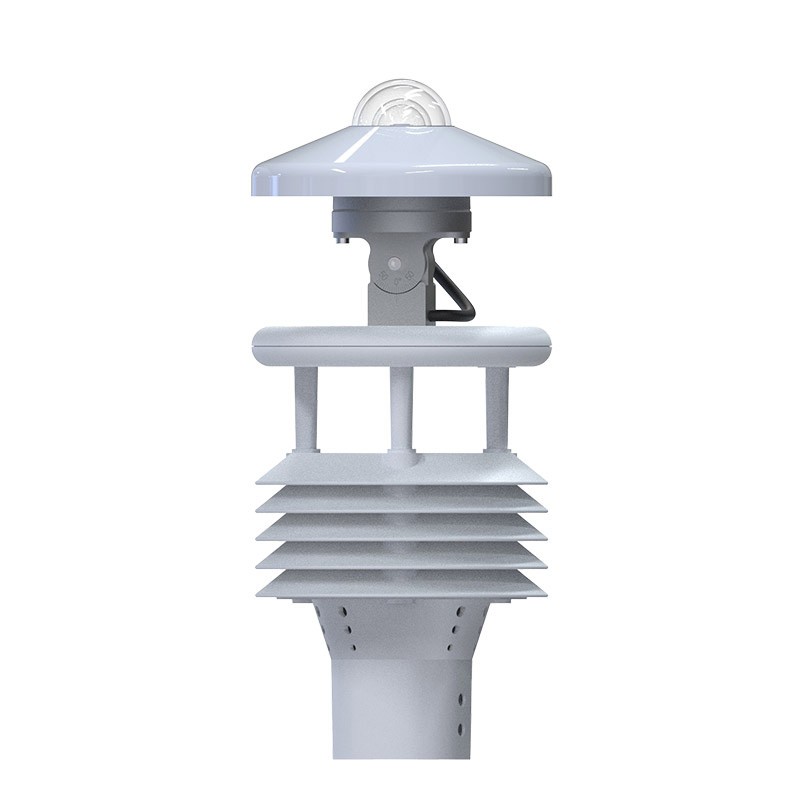
Meteorological monitoring stations designed for PV sites integrate wind speed, wind direction, temperature, humidity, atmospheric pressure, global horizontal irradiance (GHI), cumulative daily solar radiation, and PV module back-sheet temperature into a single, unified structure. Through a digital communication interface, the device outputs all eight parameters simultaneously. It utilizes an ultrasonic sensing design with concealed transducers located beneath the top cover; by emitting continuous, frequency-modulated ultrasonic signals and measuring relative phase shifts, the device determines wind speed and direction. This principle eliminates the need for mechanical moving parts, thereby removing any "starting wind speed" threshold—ensuring that data is captured even during light morning breezes. A thermopile-based pyranometer is integrated into the top of the unit, with an adjustable mounting angle (0° to 50°) to accommodate PV arrays with varying tilt angles. The back-sheet temperature sensor connects to the main unit via a six-port expansion box, eliminating the need for additional long-run cabling during on-site commissioning. The absence of moving parts—resulting in zero mechanical wear—combined with an automatic "watchdog" reset circuit, significantly reduces the maintenance frequency required for long-term operation at remote sites. All eight parameters are transmitted via an RS485 interface using a standard protocol, allowing for direct integration into PV site data acquisition systems for power forecasting, operations, and maintenance analysis.
In practical deployment, the primary challenges for meteorological monitoring stations at PV sites are ensuring data continuity and mechanical reliability during long-term outdoor exposure. Traditional cup anemometers and wind vanes are limited by a "starting wind speed" threshold, which causes wind speed readings to drop to zero during light breezes; furthermore, bearing wear leads to the gradual accumulation of measurement errors. The ultrasonic measurement principle eliminates these rotating components, while the concealed transducer design minimizes the accumulation of rain or snow in the sensing area, ensuring stable data output even at unmanned desert or rooftop installations. The measurement accuracy of the global solar irradiance directly impacts the reliability of power generation potential assessments. Moreover, the direct output of cumulative daily solar radiation eliminates the need for secondary integration (calculation) on the backend platform, thereby streamlining the data processing workflow. Backplane temperature serves as a key indicator of a module's operating status. By utilizing an expansion box for parallel connection, the system maintains a high level of integration while eliminating the noise interference typically introduced by long-run temperature-sensing cables. From an operations and maintenance perspective, the design—which requires no on-site calibration—spares field personnel from having to periodically climb towers to calibrate sensors. Furthermore, the absence of a "start-up wind speed" threshold ensures that the joint analysis of irradiance and wind speed remains accurate, preventing data gaps during the early morning hours. The standardized digital communication interface ensures compatibility with mainstream data loggers, while the ability to retrieve eight parameters in a single read cycle reduces the complexity of communication polling. This is particularly valuable for photovoltaic power plants that require high-frequency irradiance and temperature data to support ultra-short-term power forecasting.
This paper addresses:https://www.fengtuweather.com/company/1042.html
Related products

Related article
-
Functions of automatic meteorological monitoring station for field microclimate
2024-07-25 -
How Dust Monitoring Equipment Safeguards Construction Site Air Quality
2025-08-14 -
Principles and Applications of Online dust particle counter
2025-11-21 -
Fengtu Technology: Dust Monitoring Equipment and Product Series
2025-10-21 -
Miniature weather station Integrated Meteorological and Air Quality Monitoring System is suitable for field deployment
2026-02-02 -
Cleanroom Cleanliness Assurance and Online Dust Particle Counter
2025-09-09 -
Cruising - based Dust Pollution Monitoring
2025-04-30 -
Car Vehicle Mounted Auto Weather: A Flexible and Efficient Tool for Emergency Meteorological Monitoring
2025-07-28