

Product
-
Weather station
-
Road Weather Station
-
Photovoltaic Inspection
-
Atmospheric monitoring
-
Operating condition monitoring
Recommended article
- Odor gas detector Enabling Precision, Round-the-Clock Monitoring of Fugitive Emissions in Industrial Facilities
- Compact Weather Stations: High-Precision Field Monitoring for Diverse Scenarios
- Shandong Fengtu, a renowned manufacturer of environmental monitoring instruments, supplies a wide range of field and online monitoring equipment
- Weather Monitoring Equipment enables high-precision, automated environmental parameter monitoring in field settings
- Introduction to the Principles, Applications, and Technical Specifications of Speed enforcement system
- Forest Weather Station Facilitates Precise Monitoring and Scientific Prevention of Forest Fires
Contact us
Shandong Fengtu IOT Technology Co., Ltd
Sales Manager:Ms. Emily Wang
Cel,Whatsapp,Wechat:+86 15898932201
Email:info@fengtutec.com
Add:No. 155 Optoelectronic Industry Accelerator, Gaoxin District, Weifang, Shandong, China
Power Quality Measurement How to Detect Power Grid Waveform Distortion and Harmonic Content?
Article source:Weather station time:2026-05-27 09:52:50 viewed:226times
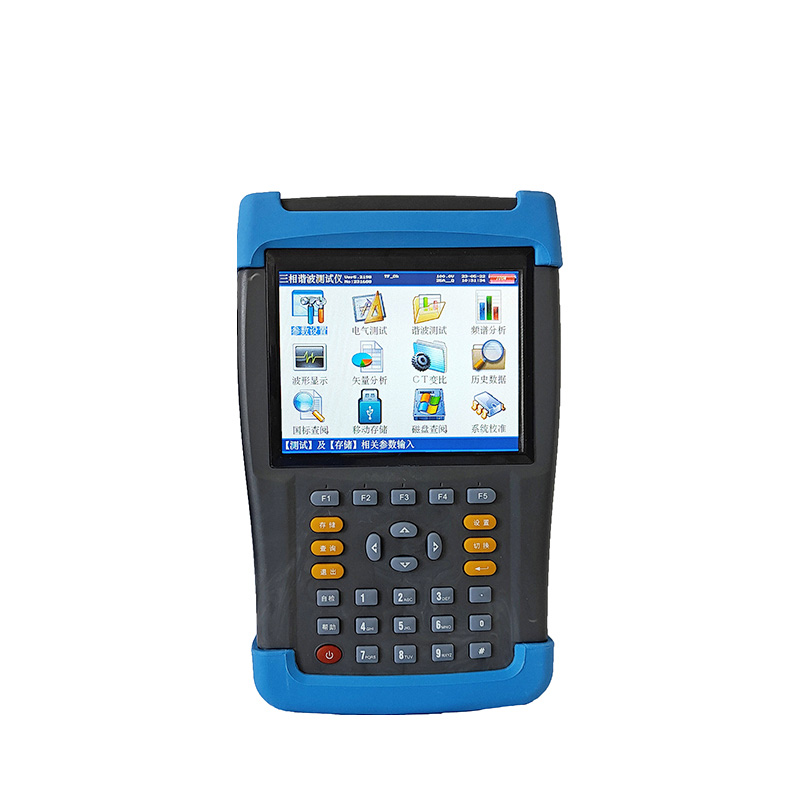
Power Quality Measurement instrument is specifically designed to detect power quality issues in the power grid, such as waveform distortion, harmonic content, and three-phase imbalance. It also features electrical parameter measurement and vector analysis capabilities, accurately measuring multiple electrical parameters including voltage, current, and power factor.
Power Quality Measurement instrument is a specialized device for detecting and analyzing the operational quality of power systems. Common problems in the power grid include waveform distortion, excessive harmonic content, and three-phase imbalance. These phenomena can lead to abnormal heating of electrical equipment, motor vibration, metering errors, and malfunctions of protection devices. The Power Quality Measurement instrument uses a high-precision sampling circuit to collect voltage and current signals from the power grid in real time. After converting analog signals into digital signals, the processor analyzes them and outputs the measurement results of various power quality indicators. This instrument can simultaneously measure multiple electrical parameters such as voltage, current, active power, reactive power, phase angle, power factor, and frequency, covering all the basic parameters required for power grid operation monitoring. In terms of functional design, the Power Quality Measurement integrates vector analysis capabilities, enabling it to examine the phase relationship between voltage and current in a three-phase system, helping field engineers quickly determine if there are wiring errors or phase sequence problems.
From a working principle perspective, the Power Quality Measurement extracts grid signals through voltage and current transformers, processes them through signal conditioning circuits, and then sends them to an analog-to-digital converter for sampling. The instrument's internal digital signal processor performs Fourier transform on the sampled data, decomposing the time-domain waveform into components of different frequencies, thereby calculating the content of each harmonic. When measuring frequency deviation and voltage fluctuations, the instrument uses a combination of zero-crossing detection and RMS calculation methods to ensure data accuracy. The calculation of three-phase unbalance is based on the positive, negative, and zero-sequence components of the three-phase voltage or current. The Power Quality Measurement achieves a measurement accuracy of ±0.1% for voltage and ±0.5% for current, and typically supports harmonic analysis from 2 to 63rd harmonics.
In terms of application scenarios, the Power Quality Measurement is widely used in power system operation and maintenance, industrial power management, and new energy grid connection detection. Power plants and substations use this equipment for routine inspections, checking for waveform anomalies and three-phase imbalances in the power supply system to identify potential equipment problems early. Factories use the Power Quality Measurement to assess the harmonic pollution level of the equipment on the power grid after installing nonlinear loads such as frequency converters and intermediate frequency furnaces. Photovoltaic power plants and wind farms need this equipment to verify the power quality of inverters during grid connection acceptance. Currently, the Power Quality Measurement on the market is mainly handheld and portable, with a built-in high-capacity lithium battery to support long-term data acquisition and a color LCD screen for real-time waveform and trend curve display. Some mid-to-high-end models also have transient capture capabilities, recording detailed waveforms of voltage swells, dips, and short interruptions, providing complete data for fault analysis. Combined with the accompanying data analysis software, users can import the measurement data stored in the instrument into a computer for long-term trend analysis and report generation.
This paper addresses:https://www.fengtuweather.com/company/949.html
Related products
Related article
-
The PV module IV tester performs volt-ampere characteristic testing on outdoor PV modules
2026-08-07 -
GNSS Monitoring Stations: Ensuring Slope Stability and Enabling Early Landslide Warning
2025-11-12 -
Inhalable Dust Continuous Tester: A Portable Solution for Dust Concentration Monitoring
2025-01-08 -
Functions of the Integrated Cloud Gauge application
2024-03-21 -
Ecological display, less scenic environment monitoring system
2024-05-24 -
FT-EC09A Odor Online Monitor: Precise Multi-Pollutant Monitoring for Odor Pollution Control
2025-06-03 -
How Miniature Sensors Aid in Accurate Fertilization for Tea Gardens
2024-10-18 -
What are the must-have equipment for a small weather station on campus?
2024-06-28