

Product
-
Weather station
-
Road Weather Station
-
Photovoltaic Inspection
-
Atmospheric monitoring
-
Operating condition monitoring
Recommended article
- Electrical Power Analyzer enables multi-channel power grid parameter acquisition and the detection of harmonics and unbalance
- Shandong Fengtu, a manufacturer of meteorological stations, offers high-precision weather observation equipment designed for field use
- Series power supply for EL-Based Internal Defect Detection in Photovoltaic Modules
- Shandong Fengtu, a manufacturer of meteorological monitoring instruments, produces advanced weather observation equipment
- Odor gas detector On-site Monitoring of Odorous Pollutants in Compliance with the GB14554 Standard
- Integrated Four-Parameter Weather Station for Field Meteorological Data Collection (Temperature, Humidity, Wind Speed, and Wind Direction)
Contact us
Shandong Fengtu IOT Technology Co., Ltd
Sales Manager:Ms. Emily Wang
Cel,Whatsapp,Wechat:+86 15898932201
Email:info@fengtutec.com
Add:No. 155 Optoelectronic Industry Accelerator, Gaoxin District, Weifang, Shandong, China
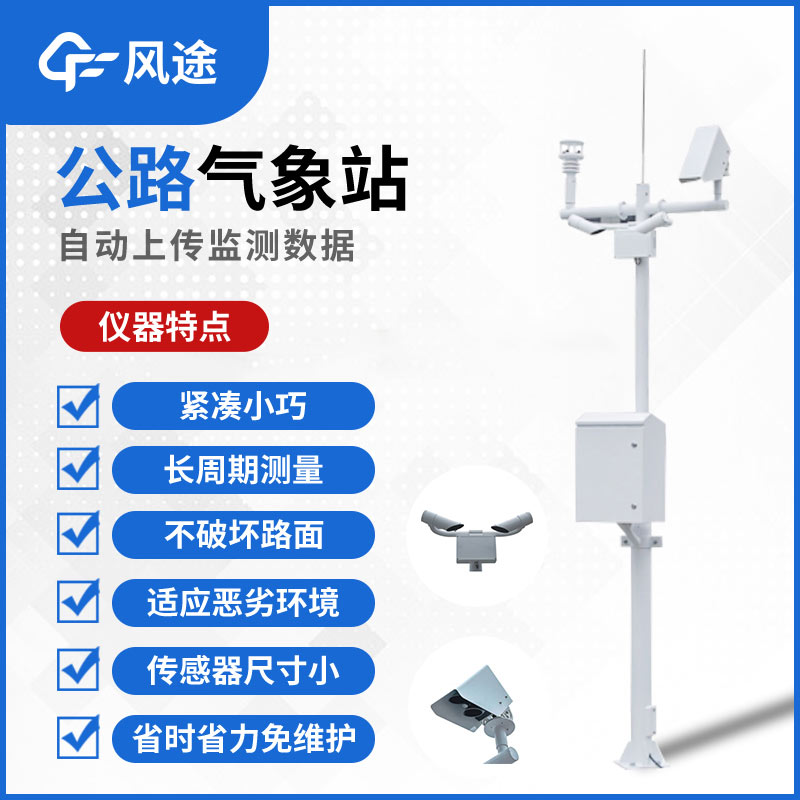
Selection of Meteorological Monitoring Equipment for Highways and Its Functions
Article source:Weather station time:2024-11-13 08:50:28 viewed:513times
In the field of meteorology, severe weather refers to those disastrous weather conditions that break out suddenly, move rapidly, are intense in strength and extremely destructive. Thunderstorm gales, hail, tornadoes, local heavy rainfall, blizzards and the like all fall into this category. The meteorological conditions on expressways have a direct impact on the highway transportation system. Meteorological situations such as rain, fog, haze, ice, snow and wind can interfere with the timeliness of transportation. In particular, phenomena like patchy fog and black ice are the meteorological factors that lead to many traffic accidents. Therefore, in order to achieve all-weather traffic on expressways, it is quite necessary to construct a meteorological monitoring and warning system.
For different types of meteorological factors, different meteorological monitoring devices should be selected. Currently, expressway meteorological monitoring is generally able to detect only when meteorological situations occur. For example, a visibility detector is installed on sections of the road that are prone to fogging, and the presence of fog can be detected once it forms; a wind sensor is installed on a cross-sea bridge, and when the wind blows, the wind force and speed can be sensed. Once the wind force exceeds level 8, corresponding management measures can be implemented.
Regarding the selection of meteorological monitoring devices, it needs to be determined according to different types of meteorological factors. For instance, if the icing situation on the road surface in winter is to be monitored, a road surface sensor needs to be installed. If the early warning of road surface icing is also to be achieved, a multi-element meteorological station should be added; if it is for the monitoring of patchy fog, a visibility meter should be installed. If the function of patchy fog early warning is to be achieved, a multi-element meteorological station and a visibility lidar should be added.
This paper addresses:https://www.fengtuweather.com/industry/554.html
Related products
Related article
-
Shandong Fengtu, a manufacturer of meteorological stations, offers high-precision weather observation equipment designed for field use
2026-10-22 -
The Crucial Role of Online dust Monitoring system in Controlling Construction Dust Pollution
2024-11-18 -
Integrated Road Weather Station: Simplifying Installation, Optimizing Monitoring
2025-04-02 -
Weather Monitoring Equipment system comprises five parts: a sensor, a data logger, a solar power supply, a pole support, and a cloud platform
2026-05-12 -
Meteorological observation station Suitable for High-Precision Meteorological Monitoring Across Diverse Field Scenarios
2026-09-16 -
Hardware configuration of forest fire risk factor monitoring stations
2024-08-06 -
Embrace Precision Monitoring with Fengtu Negative Oxygen Ion Monitoring Station
2025-02-13 -
Portable Weather Station: Your Pocket-Sized Environmental Companion
2024-11-07