

Product
-
Weather station
-
Road Weather Station
-
Photovoltaic Inspection
-
Atmospheric monitoring
-
Operating condition monitoring
Recommended article
- Electrical Power Analyzer enables multi-channel power grid parameter acquisition and the detection of harmonics and unbalance
- Shandong Fengtu, a manufacturer of meteorological stations, offers high-precision weather observation equipment designed for field use
- Series power supply for EL-Based Internal Defect Detection in Photovoltaic Modules
- Shandong Fengtu, a manufacturer of meteorological monitoring instruments, produces advanced weather observation equipment
- Odor gas detector On-site Monitoring of Odorous Pollutants in Compliance with the GB14554 Standard
- Integrated Four-Parameter Weather Station for Field Meteorological Data Collection (Temperature, Humidity, Wind Speed, and Wind Direction)
Contact us
Shandong Fengtu IOT Technology Co., Ltd
Sales Manager:Ms. Emily Wang
Cel,Whatsapp,Wechat:+86 15898932201
Email:info@fengtutec.com
Add:No. 155 Optoelectronic Industry Accelerator, Gaoxin District, Weifang, Shandong, China
Role of PV Weather Station in Real-Time Meteorological Monitoring for Photovoltaic Power Generation
Article source:Weather station time:2025-08-08 09:08:40 viewed:572times
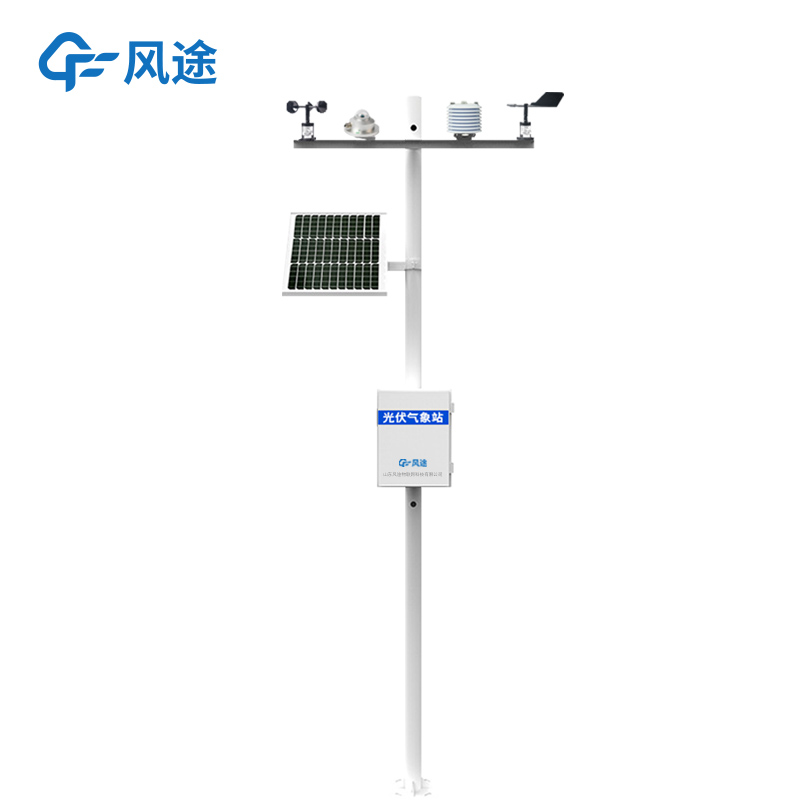
Distributed photovoltaic power generation refers to photovoltaic power generation facilities built and operated on and around users' premises, mainly for self-use on the user side, with surplus electricity connected to the power grid, and realizing balance adjustment relying on the distribution network system. In the operation of such power stations, meteorological conditions have a significant impact on power generation efficiency. The photovoltaic power station PV Weather Stationis designed to meet this demand. With the characteristics of accuracy, real-time performance and continuity, it ensures the efficient and stable operation of photovoltaic power stations. The system is mainly responsible for monitoring indicators such as total solar radiation, ambient temperature, wind speed and direction, and photovoltaic module temperature. It can either be connected to a monitoring system, which displays, records and analyzes the data, or connected to an inverter control system, which analyzes sensor data to ensure the effective operation of the photovoltaic power station.
PV Weather Stationcan accurately detect various meteorological information. Take the model that meets national standards, satisfies the requirements and logical correspondence of the latest data reported by photovoltaic power stations to the provincial dispatching, and supports the secondary upgrade of new parameters in the future as an example. It adopts a high-stability total solar radiation sensor with excellent cosine characteristics, fast response speed, zero offset and wide temperature response performance. It can accurately measure solar radiation, including direct radiation, scattered radiation and total radiation, and provide accurate values. These data are important for evaluating the power generation potential of photovoltaic power stations, because the intensity of solar radiation directly affects the power generation capacity of photovoltaic modules. With accurate solar radiation measurement data, power station operation and maintenance personnel can more scientifically plan power generation schedules and reasonably arrange power dispatching.
The system also accurately measures meteorological elements such as ambient temperature, humidity, wind speed, wind direction and air pressure. Changes in ambient temperature will affect the performance of photovoltaic modules, and accurate temperature data can help operation and maintenance personnel adjust the working status of modules in a timely manner to maintain high power generation efficiency.
It can collect meteorological data in real time and quickly transmit it to the monitoring system. The output adopts the corresponding protocol, ensuring the efficiency of data transmission. In situations where weather conditions change rapidly, real-time data is particularly important. When the rapid movement of clouds causes changes in solar radiation intensity, the weather station can detect this change at the first time and transmit the data to the control system of the photovoltaic power station. Based on real-time data, the control system quickly adjusts the working parameters of photovoltaic modules, such as adjusting the output voltage and frequency of the inverter, so that the photovoltaic power station can adapt to changes in light in a timely manner and minimize fluctuations in power generation. In the event of severe convective weather, after real-time monitoring of drastic changes in wind speed and direction, it can promptly remind power station operation and maintenance personnel to take protective measures to protect photovoltaic equipment from damage by strong winds.
PV Weather Stationalso has the ability of continuous monitoring. It works around the clock, 24 hours a day, continuously collecting meteorological data, and can adapt to various complex environments to ensure continuous operation. This continuity provides solid data support for the long-term stable operation of photovoltaic power stations. Through long-term and continuous meteorological data, operation and maintenance personnel can analyze the meteorological change rules in different seasons and different time periods, and formulate more scientific and reasonable operation and maintenance plans. In winter, based on continuously monitored low-temperature data, photovoltaic modules are pre-treated for cold protection and warmth retention; in summer, according to continuously monitored high-temperature and high-humidity data, heat dissipation and moisture-proof measures for modules are strengthened. Continuous meteorological data can also be used to evaluate the long-term power generation performance of photovoltaic power stations, providing an important reference for the optimization and upgrading of power stations.
The system has a variety of model configurations, such as basic models, standard models, and high-end models, all of which adopt I-shaped brackets, requiring no embedding or expansion screws, and are easy to install. The basic and standard models are powered by commercial electricity, while the high-end models are powered by solar energy; the output methods are different; the monitoring elements also have different focuses, which can meet the needs of different scenarios.
It has a wide range of applications, including solar photovoltaic power generation, solar energy resource assessment, solar energy system monitoring, atmospheric energy balance research, calibration and verification of solar radiation data derived from satellite inversion, thermal stress research, heat exchange research, climate change research, as well as light resource estimation and revenue evaluation in the initial stage of power stations.
This paper addresses:https://www.fengtuweather.com/industry/765.html
Related products
Related article
-
Local Air Quality Soars as Dust detector Drives Effective Pollution Control
2024-12-06 -
The All - in - One Grassland Ecological Monitoring Station (FT - CQX9)
2025-01-23 -
Road Weather Station: Serving Public Security, Transportation and Meteorological Sectors
2025-09-12 -
Portable Ground Penetrating Radar: Detecting Hidden Pipelines and Curbing Illegal Discharges in Urban Settings
2025-02-27 -
Fengtu Dust Detector: An Effective Tool for Dust pollution control
2024-12-30 -
Fengtu Visibility Meter for Precise Weather Assessment
2024-08-21 -
Scenic Weather Station: Bridging Air Quality and Sustainable Tourism through Ion Sensing
2025-06-26 -
Detecting Deep - Buried Non - Metallic Pipelines with Ground Penetrating Radar
2025-03-05