

Product
-
Weather station
-
Road Weather Station
-
Photovoltaic Inspection
-
Atmospheric monitoring
-
Operating condition monitoring
Recommended article
- Electrical Power Analyzer enables multi-channel power grid parameter acquisition and the detection of harmonics and unbalance
- Shandong Fengtu, a manufacturer of meteorological stations, offers high-precision weather observation equipment designed for field use
- Series power supply for EL-Based Internal Defect Detection in Photovoltaic Modules
- Shandong Fengtu, a manufacturer of meteorological monitoring instruments, produces advanced weather observation equipment
- Odor gas detector On-site Monitoring of Odorous Pollutants in Compliance with the GB14554 Standard
- Integrated Four-Parameter Weather Station for Field Meteorological Data Collection (Temperature, Humidity, Wind Speed, and Wind Direction)
Contact us
Shandong Fengtu IOT Technology Co., Ltd
Sales Manager:Ms. Emily Wang
Cel,Whatsapp,Wechat:+86 15898932201
Email:info@fengtutec.com
Add:No. 155 Optoelectronic Industry Accelerator, Gaoxin District, Weifang, Shandong, China
Meteorological Monitoring System: Comprehensive Functions and Modern Applications
Article source:Weather station time:2025-08-13 09:07:02 viewed:491times
In modern meteorological observation work, the Meteorological monitoring system is very common. Thanks to its automated data collection and transmission capabilities, it can generate a large amount of meteorological information, providing abundant data for research and practical applications in fields such as meteorology, agriculture, aviation, environmental science, and energy.
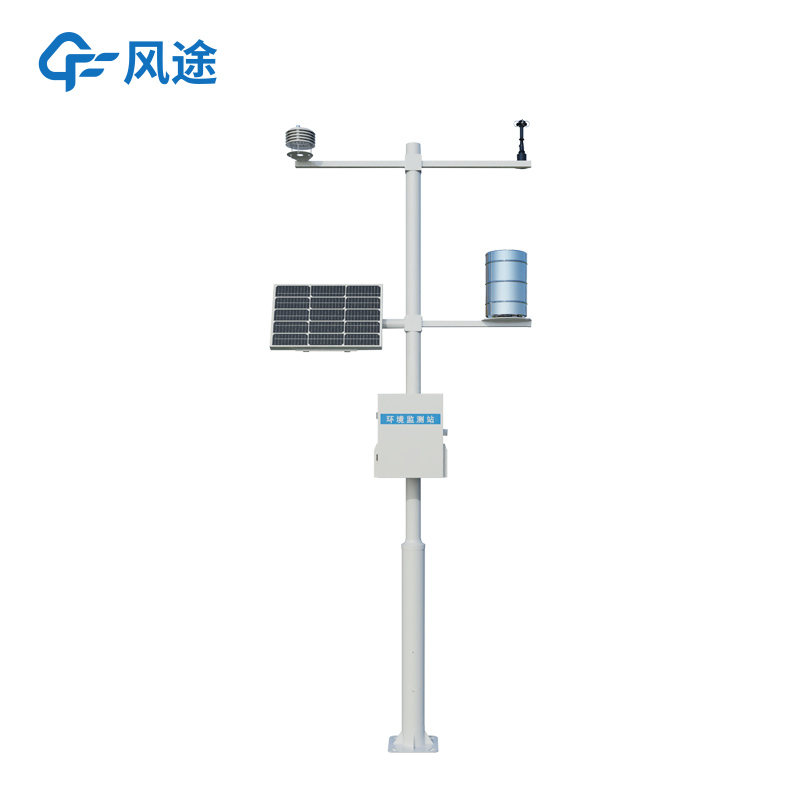
This type of equipment relies on Internet of Things technology to build a communication framework, which is divided into two parts: hardware and software. The hardware includes various sensors, poles, rainproof control cabinets, power supply systems, etc.; the software is centered on a cloud platform. Sensors are responsible for collecting various meteorological parameters, which are then transmitted to the cloud platform through the rainproof control cabinet. Users can log in to the cloud platform through mobile apps, computer software, or web pages to view information, and can also connect to terminals such as visual large screens and LED large screens to remotely and real-time understand every moment of changes in agricultural meteorology.
Its main functions are rich and diverse. Firstly, it can monitor the meteorological environment online 24 hours a day. Parameters such as carbon dioxide concentration, air pressure, rainfall, wind speed, wind direction, light intensity, air temperature and humidity, soil temperature and humidity, and particulate matter are all within the monitoring range, and the monitoring frequency can reach a high level of accuracy.
For data management, it can automatically store historical data. After the cloud platform receives the parameters, it will save them synchronously. The storage cycle is consistent with the transmission frequency, and it also supports the query, export, and printing of real-time and historical data for any time period.
When meteorological parameters exceed the set range, such as excessively high or low temperature, or excessive particulate matter concentration, the equipment will automatically send remote alarms to meteorological personnel. The reminder methods include mobile phone text messages, calls, cloud platform apps, etc.
Multiple sets of meteorological station management systems can be connected to the same cloud platform to achieve centralized management, facilitating centralized monitoring of various parameters of multiple meteorological stations.
In addition, it supports connection to network cameras, allowing monitoring screens and meteorological parameters to be transmitted synchronously and displayed on the same screen, realizing video monitoring.
In terms of account management, it allows adding multiple accounts to jointly manage the cloud platform, and can assign different permissions to each account, realizing a flexible mode where one account manages multiple devices and one device is managed by multiple accounts.
The equipment supports secondary development, can customize private platforms of different styles, and provides server API interfaces for secondary development. While expanding functions, it can also connect to systems such as smart agriculture, smart water conservancy, water-fertilizer integration, and water-saving irrigation.
The characteristics of this system are as follows: it can realize unattended monitoring, can select appropriate sensors according to on-site conditions, and automatically complete measurements remotely without the need for manual frequent trips; the communication network takes both wired and wireless into account, and can select the appropriate type according to the on-site network environment, adapting to various scenarios; the power supply methods are diverse, which can use power cords or solar energy. In the low-power state, solar power supply can work for a long time even in continuous rainy weather, and there are no special requirements for the power supply system of the application scenario; the installation mostly adopts pole-mounted or wall-mounted methods, which is simple and convenient. The management cloud platform has a full Chinese interface, which can be switched to English, with simple operation and easy learning.
This paper addresses:https://www.fengtuweather.com/industry/770.html
Related products
Related article
-
Mobile Monitoring Applications and Performance Advantages of Vehicle-Mounted Five-Parameter Meteorological Equipment
2026-09-08 -
Scenic Weather Station: Empowering Tourism with Meteorological Resources
2024-09-26 -
FT-CZ5S Vehicle Weather Station: Mobile 5-Element Visual Meteorological Monitoring System
2025-10-30 -
How does the Handheld Weather StationFT-SQ7B perform?
2024-08-14 -
Forestry Weather Station: A Powerful Tool for Forest and Grassland Fire Prevention and Control
2025-07-08 -
Fengtu's Weather Monitoring Equipment: Versatile, Customizable and Network-Ready
2025-08-05 -
Atmospheric Environment Monitoring System: The Key to Precise Pollution Control”
2024-10-11 -
Multifunctional weather station Enables Real-Time Online Monitoring of Oil Conditions
2026-05-19