

Product
-
Weather station
-
Road Weather Station
-
Photovoltaic Inspection
-
Atmospheric monitoring
-
Operating condition monitoring
Recommended article
- Weather Instruments Supports High-Precision Meteorological Data Collection in Field Environments
- Electrical Power Analyzer enables multi-channel power grid parameter acquisition and the detection of harmonics and unbalance
- Shandong Fengtu, a manufacturer of meteorological stations, offers high-precision weather observation equipment designed for field use
- Series power supply for EL-Based Internal Defect Detection in Photovoltaic Modules
- Shandong Fengtu, a manufacturer of meteorological monitoring instruments, produces advanced weather observation equipment
- Odor gas detector On-site Monitoring of Odorous Pollutants in Compliance with the GB14554 Standard
Contact us
Shandong Fengtu IOT Technology Co., Ltd
Sales Manager:Ms. Emily Wang
Cel,Whatsapp,Wechat:+86 15898932201
Email:info@fengtutec.com
Add:No. 155 Optoelectronic Industry Accelerator, Gaoxin District, Weifang, Shandong, China
Solar Powered Weather Station Enabling Unattended Field Monitoring via MPPT Technology
Article source:Weather station time:2026-04-17 10:48:42 viewed:323times
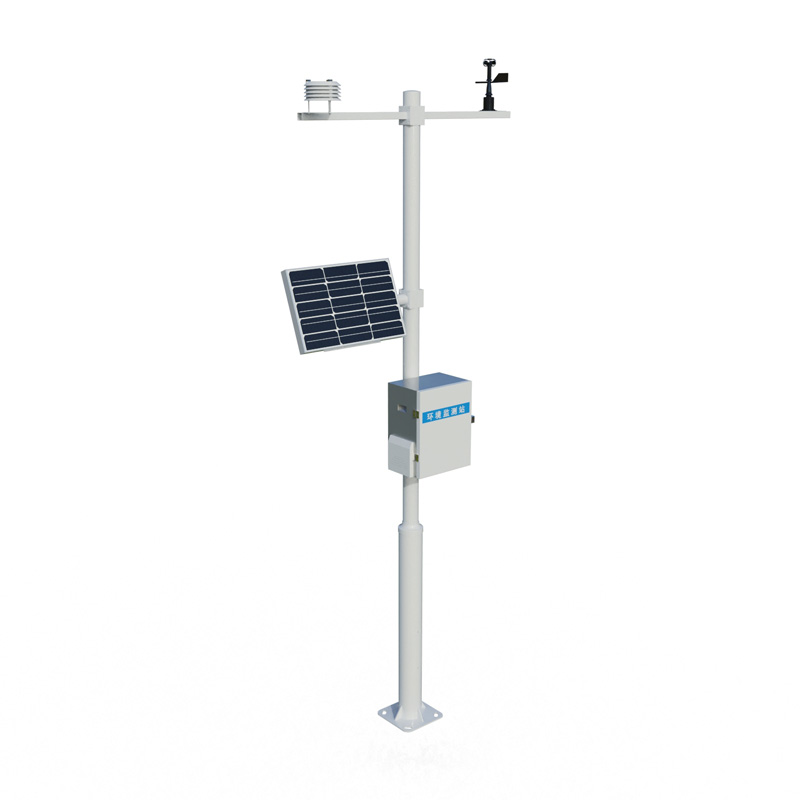
Solar Powered Weather Station comprises five key components: meteorological sensors, a data collector, a solar power supply system, a pole mount, and a cloud platform. It utilizes MPPT (Maximum Power Point Tracking) charge management technology, boosting charging efficiency by 20%. The device is capable of continuously collecting meteorological parameters—such as air temperature, humidity, illuminance, wind speed, wind direction, rainfall, and atmospheric pressure—over extended periods. Specifically engineered for long-term field monitoring, it employs wireless data transmission, thereby eliminating the need for physical cabling.
Solar Powered Weather Station is a comprehensive, unattended meteorological monitoring system that integrates data acquisition, storage, transmission, and management capabilities. Primarily designed for deployment in outdoor and remote environments, the device resolves the long-standing challenge faced by traditional weather stations: the inability to operate in areas lacking access to mains electricity. The system's core advantage lies in its complete reliance on solar power; by eliminating the need to lay power lines, it ensures continuous, long-term operation.
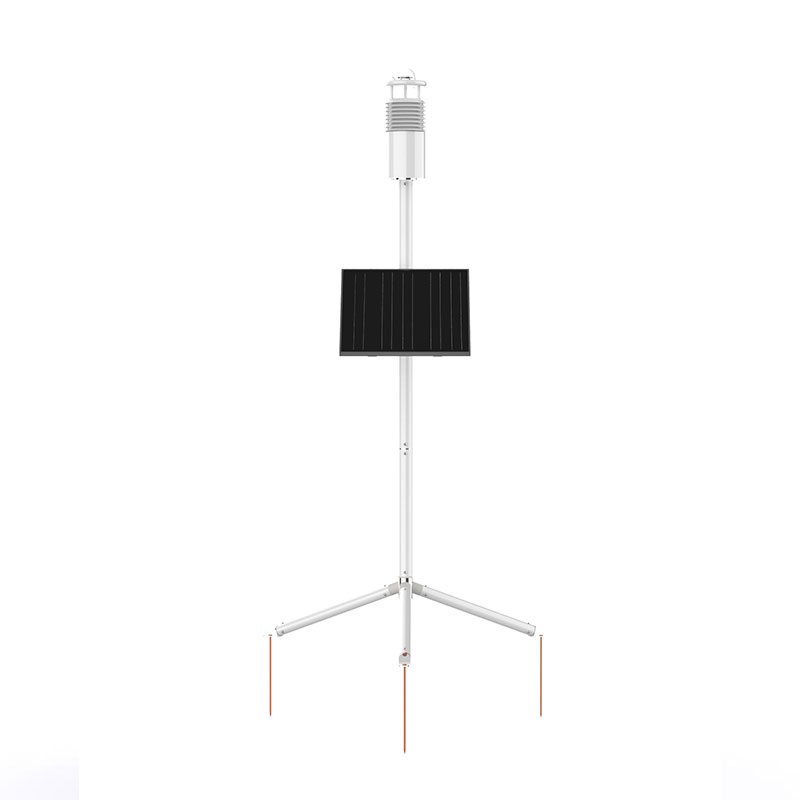
The hardware component of Solar Powered Weather Station consists of five distinct modules: meteorological sensors, a data collector, a solar power supply system, a pole mount, and a cloud platform. The meteorological sensors are responsible for capturing fundamental weather parameters—including air temperature, relative humidity, light intensity, wind speed, wind direction, rainfall, and atmospheric pressure—while users can flexibly select the specific types and quantities of sensors to meet their actual monitoring requirements. The data collector is powered by a low-power, industrial-grade processor, enabling the device to maintain normal operation for extended periods even in the absence of sunlight, thereby guaranteeing uninterrupted data acquisition even during prolonged periods of overcast or rainy weather. The pole mount is constructed from either aluminum-titanium alloy or carbon steel; its surface undergoes hot-dip galvanization and electrostatic powder coating treatments to ensure superior corrosion resistance, making it adaptable to a wide variety of ground installation conditions.
Regarding its power supply system, Solar Powered Weather Station employs an MPPT charge controller. By dynamically tracking the maximum power point of the photovoltaic panel under varying light conditions, MPPT technology optimizes the voltage and current matching, resulting in a charging efficiency increase of approximately 20% compared to traditional PWM controllers. The device comes standard with a lead-acid battery, offering three optional power configurations: 30W/20AH, 50W/40AH, and 100W/100AH. Users can select the appropriate configuration based on local sunlight conditions and the device's power consumption requirements. The charging controller features a 150W capacity and incorporates short-circuit, open-circuit, and overheat protection functions, enabling it to meet the demands of long-term operation in various extreme environments.
Regarding data transmission, the Solar Powered Weather Station utilizes wireless communication technology. It comes standard with a universal 4G module and offers optional transmission solutions—including GPRS, LoRa, RS485, and Ethernet—to suit diverse needs. It supports a "multi-station broadcasting" function, allowing data to be transmitted simultaneously to multiple central stations. All monitoring data is uploaded to a cloud platform via a wireless network; users can access and view real-time metrics—such as air temperature, humidity, wind speed, and rainfall—via a web interface or mobile application. The system also supports historical data querying, exporting, and statistical analysis.
The Solar Powered Weather Station is suitable for a wide range of fields, including meteorology, agriculture, forestry, environmental protection, marine science, airport and port operations, scientific research, and campus education. It operates stably in various outdoor environments—such as deserts, high-altitude plateaus, farmlands, mountainous regions, and coastal areas—providing continuous and reliable meteorological data support for environmental monitoring and scientific management.
This paper addresses:https://www.fengtuweather.com/technical/924.html
Related products
Related article
-
Real-time data from the road meteorological monitoring system supports traffic early warning
2026-06-01 -
Functions of the Integrated Cloud Gauge application
2024-03-21 -
Vehicle-Mount Weather Stations: Mobile Solutions for Environmental Monitoring and Air Quality Analysis
2025-05-26 -
The Electrical Power Analyzer's four-channel synchronous measurement capability enhances the efficiency of photovoltaic grid-connected testing
2026-07-17 -
Cruising - based Dust Pollution Monitoring
2025-04-30 -
photovoltaic testers is designed for high-precision testing at large-scale photovoltaic (PV) power plants
2026-09-11 -
Fengtu Online Dust Monitoring System: Functions, Applications and Information Display Modes
2025-08-18 -
Tailored for Emergencies: The Complementary Advantages of Two Weather Monitoring Tools
2025-04-22