

Product
-
Weather station
-
Road Weather Station
-
Photovoltaic Inspection
-
Atmospheric monitoring
-
Operating condition monitoring
Recommended article
- Odor gas detector Enabling Precision, Round-the-Clock Monitoring of Fugitive Emissions in Industrial Facilities
- Compact Weather Stations: High-Precision Field Monitoring for Diverse Scenarios
- Shandong Fengtu, a renowned manufacturer of environmental monitoring instruments, supplies a wide range of field and online monitoring equipment
- Weather Monitoring Equipment enables high-precision, automated environmental parameter monitoring in field settings
- Introduction to the Principles, Applications, and Technical Specifications of Speed enforcement system
- Forest Weather Station Facilitates Precise Monitoring and Scientific Prevention of Forest Fires
Contact us
Shandong Fengtu IOT Technology Co., Ltd
Sales Manager:Ms. Emily Wang
Cel,Whatsapp,Wechat:+86 15898932201
Email:info@fengtutec.com
Add:No. 155 Optoelectronic Industry Accelerator, Gaoxin District, Weifang, Shandong, China
Meteorological Station Siting Must Satisfy Three Fundamental Requirements Representativeness, Accuracy, and Comparability
Article source:Weather station time:2026-04-13 09:53:58 viewed:362times
The selection of a site for a meteorological station must satisfy three fundamental requirements: representativeness, accuracy, and comparability. The station site should be situated in an open, flat area, avoiding valleys and depressions. The distance between the observation field and any isolated obstruction must be at least three times the height of the obstruction; for large-scale obstructions, this distance must exceed ten times their height. Furthermore, no tall-stalked crops may be planted within a 10-meter radius of the site.
The siting of a meteorological station directly determines the quality of the meteorological data generated. According to the *Technical Requirements for Siting National Meteorological Observation Stations* (QX/T 684-2023) and the *Technical Requirements for Siting National Basic Meteorological Stations* (QX/T 685-2023)—both issued by the China Meteorological Administration—meteorological station siting must fulfill three core requirements: representativeness, accuracy, and comparability. Representativeness implies that the observed data accurately reflect the weather and climate characteristics of the majority of the surrounding region; accuracy implies that the observational records truthfully reflect actual meteorological conditions; and comparability implies that data collected from different stations can be effectively compared.
Regarding geographical location, a meteorological station should be constructed at a site that is representative of the surrounding region's climatic characteristics. It should ideally be situated upwind of the prevailing local wind direction, while avoiding topographical features such as valleys, depressions, steep slopes, and sheer cliffs. The observation field is required to be flat and open on all sides, free from nearby interference sources such as tall buildings, industrial or mining facilities, and smokestacks. A 1,000-meter radius surrounding the observation field is designated as a "detection environment protection and control zone"; within this zone, the ratio of any building's height to its distance from the observation field must be less than 1:10, and the minimum distance between any obstruction and the observation field's perimeter fence must be no less than 50 meters. Furthermore, the obstruction elevation angle in the directions of sunrise and sunset (based on the local azimuths for sunrise and sunset) must not exceed 5 degrees.
Regarding the control of environmental conditions, a meteorological station should be situated at a safe distance from various potential sources of interference. The minimum distance between the observation field's perimeter fence and a railway embankment must exceed 200 meters; the minimum distance from a highway embankment must exceed 50 meters; the minimum distance from any artificially constructed body of water must exceed 100 meters; and the minimum distance from interference sources such as landfills or sewage outlets must exceed 500 meters. No tall-growing crops may be planted within a 10-meter radius surrounding the observation field, in order to ensure unimpeded airflow. The perimeter of the observation field should be enclosed by a sparse fence approximately 1.2 meters in height; the field itself must maintain a uniform grass cover, with the grass height not exceeding 20 centimeters.
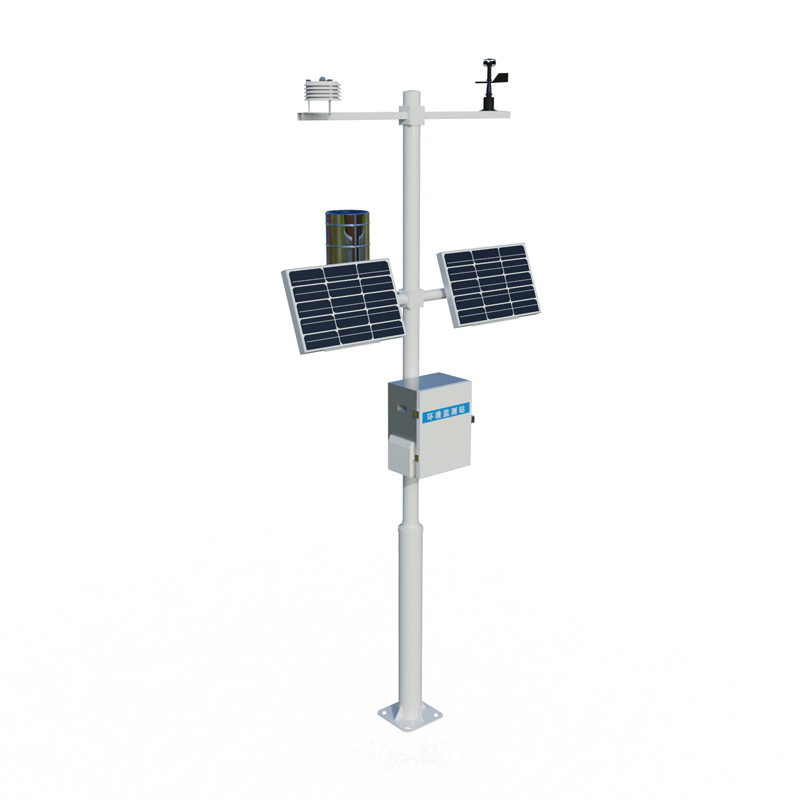
Regarding equipment layout, a surface meteorological observation field should be oriented along north-south and east-west axes, with a standard dimension of 25 meters by 25 meters. The installation of instruments within the field adheres to the following principles: "maintain adequate spacing to prevent mutual interference; arrange from north to south in descending order of height, and align in rows from east to west; and position instruments near pathways to facilitate observation." The north-south spacing between instruments must be no less than 3 meters, the east-west spacing no less than 4 meters, and the distance from any instrument to the perimeter fence no less than 3 meters. The station building housing the meteorological facilities is typically constructed to the north of the observation field. Once established, a meteorological station should maintain long-term stability and should not be relocated without compelling reason, so as to preserve the continuity of the observational data.
This paper addresses:https://www.fengtuweather.com/industry/920.html
Related products
Related article
-
Shandong Fengtu, an environmental monitoring station manufacturer, focuses on the R&D and manufacturing of meteorological monitoring equipment
2026-07-01 -
Forestry Weather Station Determining Fire Risk Levels via Meteorological Factor Monitoring
2026-03-23 -
10 metre manual common lightning rod is convenient and easy to use
2024-04-25 -
Automatic Farmland Weather Station
2024-08-20 -
I-V Curve Tracer enables highly efficient and precise electrical performance testing of photovoltaic (PV) modules
2026-09-17 -
Ground Penetrating Radar: Non-Destructive Precision Detection for Voids Beneath Building Floors
2025-07-17 -
Radar speed gun Integrated Printer Enables On-Site Printing of Speeding Data
2026-03-24 -
Road Weather Station: Real-Time Monitoring and Early Warning for Safe Traffic Operations
2025-06-05