

Product
-
Weather station
-
Road Weather Station
-
Photovoltaic Inspection
-
Atmospheric monitoring
-
Operating condition monitoring
Recommended article
- Weather Instruments Supports High-Precision Meteorological Data Collection in Field Environments
- Electrical Power Analyzer enables multi-channel power grid parameter acquisition and the detection of harmonics and unbalance
- Shandong Fengtu, a manufacturer of meteorological stations, offers high-precision weather observation equipment designed for field use
- Series power supply for EL-Based Internal Defect Detection in Photovoltaic Modules
- Shandong Fengtu, a manufacturer of meteorological monitoring instruments, produces advanced weather observation equipment
- Odor gas detector On-site Monitoring of Odorous Pollutants in Compliance with the GB14554 Standard
Contact us
Shandong Fengtu IOT Technology Co., Ltd
Sales Manager:Ms. Emily Wang
Cel,Whatsapp,Wechat:+86 15898932201
Email:info@fengtutec.com
Add:No. 155 Optoelectronic Industry Accelerator, Gaoxin District, Weifang, Shandong, China
Controlling Erosion & Dust: FT-QX9 Meteorological System for Hydropower Spoil Management
Article source:Weather station time:2025-06-23 09:53:12 viewed:499times
During the construction of hydropower stations, a large amount of waste soil and stone slag generated requires specialized sites for stacking, which are known as spoil disposal sites of hydropower stations. As auxiliary facilities for engineering construction, spoil disposal sites are located near mountains and waters. They need to consider both the proximity for reducing transportation costs and the avoidance of ecological damage to the surrounding areas. However, without effective supervision, heavy rainfall can easily trigger debris flows due to erosion, and wind-driven dust can pollute the air. These environmental risks are all related to meteorological conditions.
Aiming at the special environment of spoil disposal sites, meteorological monitoring should focus on four core elements. First is rainfall monitoring: by recording rainfall intensity and cumulative rainfall, it can predict potential landslide hazards. Second is wind speed and direction monitoring: especially in windy weather, it is necessary to grasp the diffusion direction of dust. Temperature and humidity monitoring is used to analyze the physical changes inside the spoil heap: high temperature and dryness can easily cause spontaneous combustion, while a humid environment may lead to soil softening. Finally, air pressure monitoring, combined with other data, can provide early warnings of extreme weather.
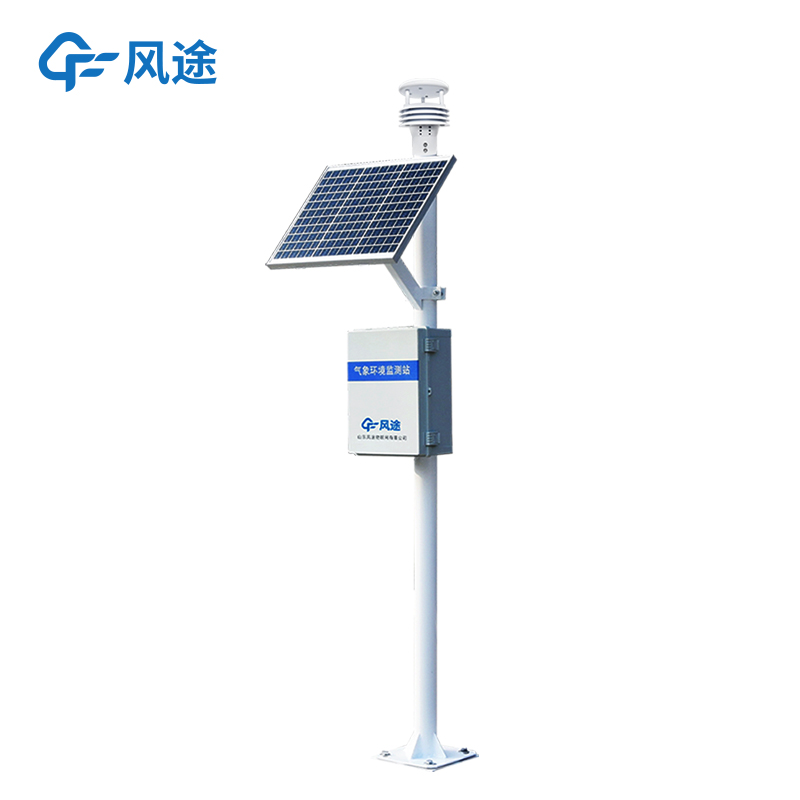
The FT-QX9 Meteorological monitoring system launched by Fengtu IoT is particularly suitable for complex working conditions like spoil disposal sites. This monitoring equipment adopts a modular design, integrating nine types of meteorological sensors, including ultrasonic anemometers, high-precision temperature and humidity probes, tipping bucket rain gauges, etc. The sensor housing is made of ASA engineering plastic with anti-aging treatment on the surface, enabling use in acid rain and salt spray environments.
For data transmission, the system offers multiple options. In areas with good signals, GPRS can transmit data in real time. In network-blind areas, data can be stored locally first. The device is equipped with a solar power supply system combined with a large-capacity lithium battery, ensuring normal operation even during 15 consecutive rainy days, thus solving the power supply problem in remote areas. With such a monitoring system, managers of hydropower stations can master "weather codes" to layout preventive measures in advance and protect the ecological safety of spoil disposal sites.
This paper addresses:https://www.fengtuweather.com/industry/729.html
Related products
Related article
-
Automated Monitoring for Geological Disasters: Solutions for Hazard Point Detection and Early Warning
2025-06-13 -
PV Module Power Testers Enable Rapid On-Site IV Curve Testing
2026-04-22 -
Effective Measures for Construction Site Dust Control with Online dust Monitoring system
2024-12-02 -
Addressing Forest Fire Risks with Our Forestry Weather Station: Prevention & Early Warning
2025-08-19 -
Forest fire weather station, fire prevention, observation of ecology
2024-04-01 -
Dust Detector: Enabling Real-Time Monitoring, Automatic Alarming and Linked Dust Suppression
2025-09-05 -
Hardware configuration of forest fire risk factor monitoring stations
2024-08-06 -
Dust Detector: Key to Monitoring and Mitigating TSP, PM2.5 and PM10 at Construction Sites
2025-05-09